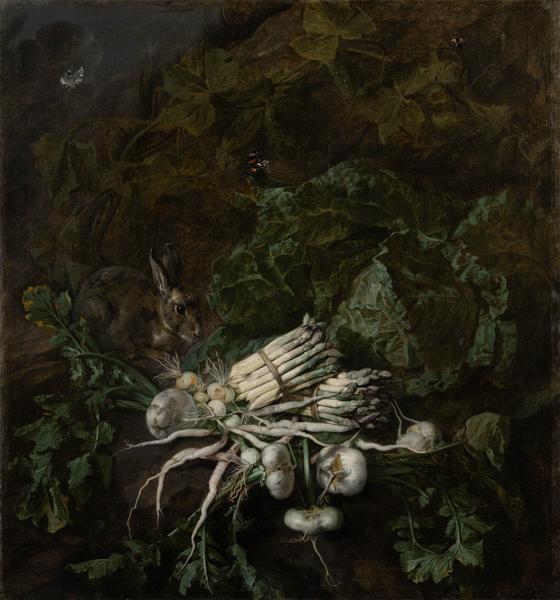
Still Life with a Rabbit
Jan van Kessel


Basic information
- ID
- Ж-781
- Author
- Jan van Kessel
- Name
- Still Life with a Rabbit
- Date of creation
- 1652
- Technique
- oil painting
- Material
- canvas oil
- Dimensions (height x width, cm)
- 108 x 98.5
Additionally
- Type
- painting
- Genre
- still life animal painting
- Plot
- Still life
- Provenance
- the Lubomirski collection
- Exposition
- Potocki Palace
Information about author
Object description
In the 17th century, in the background of social and political cataclysms, wars, and epidemics, the theme of the four primordial elements of the world, which, when united, create harmony, became one of the most prevalent in artistic culture and philosophical debates in Europe. The primary elements of the universe – air, fire, earth, and water – were depicted in fine art not only visually but also through symbols and attributes. "Still Life with a Rabbit" by Jan van Kessel (ca. 1620 – ca. 1661) from the collection of Borys Voznytskyi Lviv National Art Gallery is an example of such a painting. The painting from the Gallery's collection depicts a life-size hare, a bunch of asparagus, a sprawling cabbage rosette, and various crops with butterflies flying over them in a general silver tonality. The image appears from above as if plucked from the flow of life. The painting is an excellent example of a typical 17th-century "rhetorical receptive model" based on symbolism, cultural codes, and meaningful subtexts. The knowledgeable viewer of the Baroque era perceived vegetables as a symbol of the earthly elements, butterflies as air, and hares as symbols of fertility and the infinity of the flow of life. The era is distinguished by "consecutive double symbolisation" and the development of "associative symbolic chains". As a result, the four primary elements acquired a valuable meaning: the earth was associated with peace, strength, and dignity; the air with soul, spirit, inspiration, and freedom; and their unity – with the harmony of existence. A work similar to the one in Lviv, dated 1655, with the same compositional elements but depicting a rabbit as a trophy, is housed in the Duke Anton Ulrich Museum in Braunschweig.
Legal regulation
Borys Voznytskyi Lviv National Art Gallery