Sketch for a Mural
Vasyl Poliovyi


Basic information
- ID
- Ж-8173
- Author
- Vasyl Poliovyi
- Name
- Sketch for a Mural
- Country
- the USSR
- Culture
- Ukrainian art of the Soviet period
- Technique
- mixed technique
- Material
- kraft paper particleboard tempera
- Dimensions (height x width, cm)
- 40 x 70
Additionally
- Type
- painting
- Genre
- symbolic art
- Plot
- Allegory
- Provenance
- Handed over to the museum from Vasyl Poliovyi
Information about author
Object description
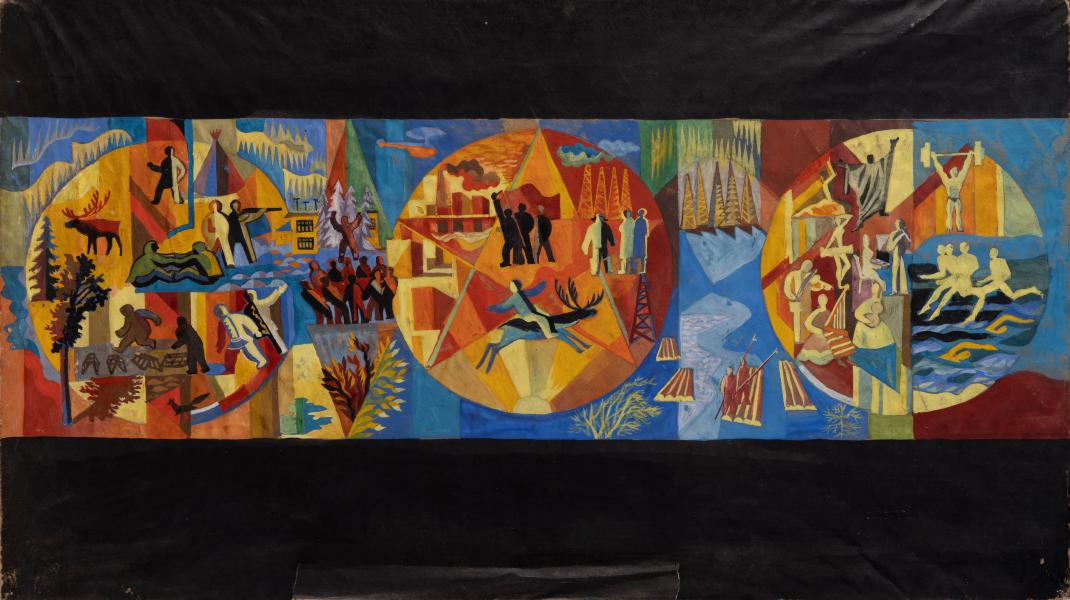
The work (21 х 70 cm) is one of a series of sketches by Vasyl Poliovyi that depict the culture and life of the people living in the Far North of the USSR. It is worth noting that the author's paintings, including a portrait of a boy in national costume, date from the same period. The main focus of the plot is the development of a gallery of symbolic signs, how representatives of these ethnic groups, who led an original way of life with characteristic activities such as hunting and fishing, developed within the framework of the new political system and orientation towards the industrial, scientific, and technological revolution. The author presents three scenes in which we can see the traditional way of life of hunters, probably dressed in kukhlianka or kamleika (it is difficult to determine the exact type of clothing due to stylisation).
The circle on the left shows representatives of an unidentified northern ethnic group (probably Nenets or Koriaks) who spent most of their time outside their camps (the upper part of the composition shows a traditional dwelling, a yaranga, moved to the right). These peoples were involved in traditional activities such as reindeer herding (in the left part of the composition, there is a figure of this animal with a characteristic silhouette which allows us to identify it as Rangifer tarandus), hunting, particularly for fur-bearing animals (at the bottom there is a small figure of a sable (Latin Martes zibellina) or another local member of the marten family), and fishing. The work reflects modernisation through the image of a rifle in the hands of one of the hunters. It should be noted that this man is aiming at the figure of the agitator in the second circle, which contradicts the worldview that shooting at people is taboo. The diamond between the left and central circles shows a group of people on a lawn, in the depths of which there is probably a research station from which a helicopter (probably MI-1, given the stylisation) is flying. In the central circle, the space is arranged so that the silhouette of a five-pointed star can be seen (a stylised sun with rays is depicted below).
There, we see a group of people symbolising the modernisation of the Far North during the Soviet era, including the silhouette of a factory (probably a rare earth metallurgical plant), gas towers with workers in typical working clothes (including a characteristic insulated hat explicitly made for work in this region). In the lower part, a man riding a reindeer across the sun is depicted as having fun rather than performing a purposeful action. In the band between the central and right circles are gas towers and figures of rafters. The right circle contains a series of images typical of Soviet monumental art: allegorical figures of theatre actors, a ballerina, a violinist, a guitarist, a harpist, a pianist and probably a clarinettist, as well as weightlifters and runners. At the same time, the stylistic representation of the subjects refers to the practices of avant-garde art, with its characteristic rich contrasts of colour and formal approach, as seen, for example, in the works by Volodymyr Maiakovskyi and other authors of the ROSTA Windows (1919–1921).
At the same time, the approach to composition can be interpreted as a manifestation of the influence of iconographic practices, particularly in the context of the simultaneity and symbolism of events in individual "stereotypes" and their placement on a stylised background that reflects the timeless chronotope of nature of the North.
The circle on the left shows representatives of an unidentified northern ethnic group (probably Nenets or Koriaks) who spent most of their time outside their camps (the upper part of the composition shows a traditional dwelling, a yaranga, moved to the right). These peoples were involved in traditional activities such as reindeer herding (in the left part of the composition, there is a figure of this animal with a characteristic silhouette which allows us to identify it as Rangifer tarandus), hunting, particularly for fur-bearing animals (at the bottom there is a small figure of a sable (Latin Martes zibellina) or another local member of the marten family), and fishing. The work reflects modernisation through the image of a rifle in the hands of one of the hunters. It should be noted that this man is aiming at the figure of the agitator in the second circle, which contradicts the worldview that shooting at people is taboo. The diamond between the left and central circles shows a group of people on a lawn, in the depths of which there is probably a research station from which a helicopter (probably MI-1, given the stylisation) is flying. In the central circle, the space is arranged so that the silhouette of a five-pointed star can be seen (a stylised sun with rays is depicted below).
There, we see a group of people symbolising the modernisation of the Far North during the Soviet era, including the silhouette of a factory (probably a rare earth metallurgical plant), gas towers with workers in typical working clothes (including a characteristic insulated hat explicitly made for work in this region). In the lower part, a man riding a reindeer across the sun is depicted as having fun rather than performing a purposeful action. In the band between the central and right circles are gas towers and figures of rafters. The right circle contains a series of images typical of Soviet monumental art: allegorical figures of theatre actors, a ballerina, a violinist, a guitarist, a harpist, a pianist and probably a clarinettist, as well as weightlifters and runners. At the same time, the stylistic representation of the subjects refers to the practices of avant-garde art, with its characteristic rich contrasts of colour and formal approach, as seen, for example, in the works by Volodymyr Maiakovskyi and other authors of the ROSTA Windows (1919–1921).
At the same time, the approach to composition can be interpreted as a manifestation of the influence of iconographic practices, particularly in the context of the simultaneity and symbolism of events in individual "stereotypes" and their placement on a stylised background that reflects the timeless chronotope of nature of the North.
Legal regulation
Borys Voznytskyi Lviv National Art Gallery