Nesterov
Margit Selska (Reich)


Basic information
- ID
- Ж-5877
- Author
- Margit Selska (Reich)
- Name
- Nesterov
- Date of creation
- 1946
- Country
- the Ukrainian SSR
- Culture
- Contemporary times
- Technique
- oil painting
- Material
- canvas oil
- Dimensions (height x width, cm)
- 57.5 x 48
Additionally
- Type
- painting
- Genre
- landscape
- Plot
- Landscape
- Provenance
- Gifted by Roman Selskyi, 1983
Information about author
Object description
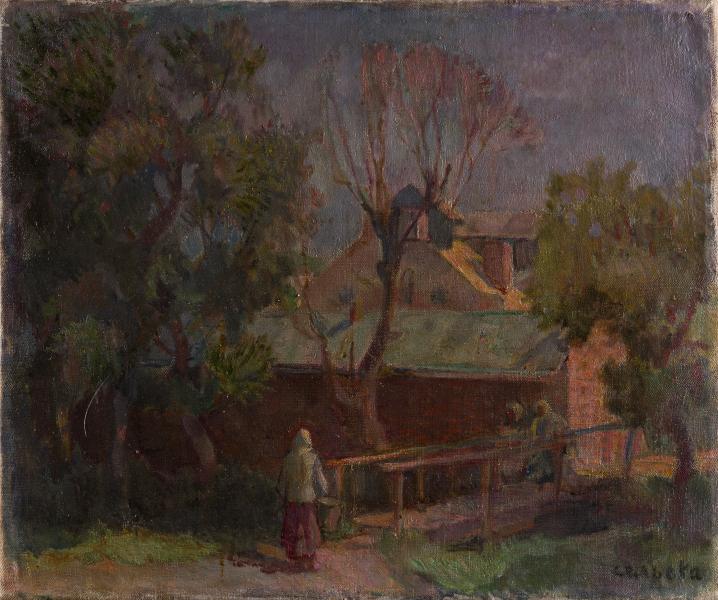
The landscape "Nesterov" (1946), depicting a corner of the town, now restored to its historical name of Zhovkva, shows M. Selska's attempts to preserve the freedom of form creation in the face of the imposition of social realist requirements. Thus, the three-dimensional and detailed reproduction of a one-storey building, trees, a bridge, a pair of travellers and a single female figure demonstrates compliance with mimetic principles. At the same time, the work confirms the preservation of the artist's own culture of colour expression, oriented towards the traditions of the Kapists and the French School of Painting at the turn of the 19th and 20th centuries. The dominance of colour in creating an evocative image can be seen in the unity of the picture with a golden tone, the richness of the texture, and the delicate play of warm and cold tones. An unintentional appeal to the archetypes and symbols of folk culture is perceived in the image of a bridge – a place of transition that in legends, fairy tales and beliefs symbolises overcoming obstacles, reaching a new state or status; it connects heterogeneous spaces, is one of the most important and dangerous parts of the journey.
Inscriptions
In the lower right corner is the inscription: "Selska".
Legal regulation
Borys Voznytskyi Lviv National Art Gallery