Drawings of Six Male Busts
Yulian Zaiats


Basic information
- ID
- Ф-З-Арх-ЛГМ-5/6
- Author
- Yulian Zaiats
- Name
- Drawings of Six Male Busts
- Date of creation
- 1991
- Country
- German Empire (?)
- Technique
- drawing
- Material
- paper charcoal pencil
- Dimensions (height x width, cm)
- 29.9 x 21.8
Additionally
- Type
- graphic art
- Genre
- portraiture
- Plot
- Portrait
- Provenance
- Received from Nina Zaiats
Information about author
Object description
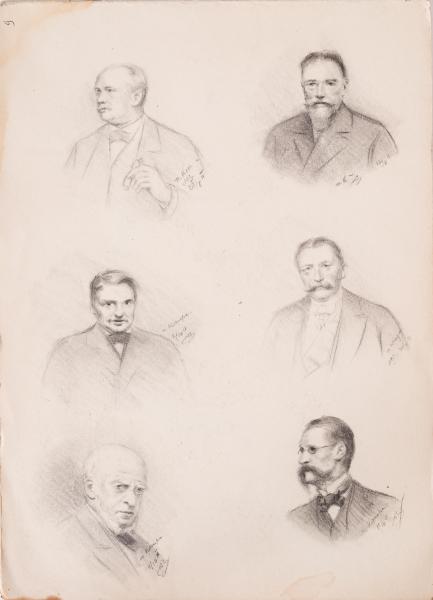
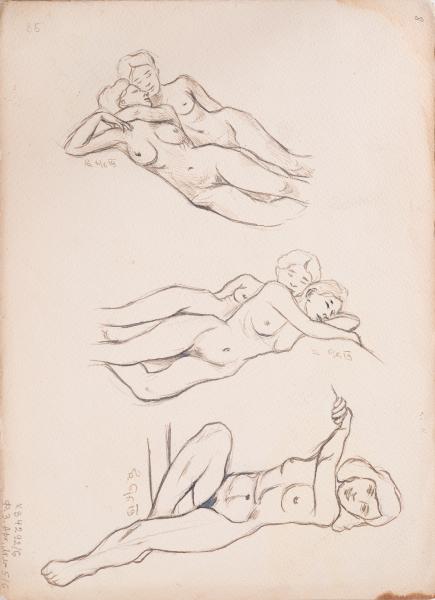
Six portrait sketches of elderly men are arranged on a sheet of paper, modelled after a work by an unknown artist (the signature is difficult to read), a contemporary of Yulian Zaiats (as evidenced by the specific clothing). The work is done in charcoal and pencil, and on the reverse side, probably in brown ink. The images are arranged in three rows of two, maintaining the symmetry and harmony of the composition. Each figure has a distinct pose, facial expression, and expressive psychological character, which testifies to the author's skill in capturing images and reproducing types. Each portrait is accompanied by captions and initials, along with dates, mostly from October 1911. This indicates systematic work as part of the educational process or self-study of model drawing. Most of the people in the portraits, based on their appearances, seem to be from an educated group with some wealth — they have moustaches, beards, hairstyles, suits with bow ties or ties, which also hints at the possible social status of the models and fits the fashion of the early 20th century. The drawing technique demonstrates skill in modelling volumes using hatching and chiaroscuro, as well as accurate reproduction of facial proportions, characteristic features of the skull's anatomy, and hair texture. The author employs soft gradations of shadows and delicate chiaroscuro modeling, a hallmark of high-level academic drawing. The drawing has documentary value as a visual source of the history of its time and the peculiarities of Yulian Zaiats' creative development in particular. On the reverse side of the sheet, there are two groups of nude female figures and one female figure (rotated 90º vertically relative to the others) sitting, leaning on an unidentified object. All images are executed in the technique of academic graphic drawing. The compositions consist mainly of pairs of women depicted in a reclining position, with combined gestures, twists of the torso, and glances. This suggests a stage of exploration in which the artist was mastering the complex form of interaction between human bodies in space. Given the dates and nature of the drawings, it can be assumed that the letter was part of an individual study of figure drawing in group dynamics. All figures have free but confident contours, with shadows marked concisely and with a distinct stroke. The focus is not so much on detail as on the plastic solution and the correct anatomical connection of the bodies. In the upper composition, the emphasis is on physical contact and emotional expressiveness, the middle one demonstrates the rhythm of lines and symmetry of bodies, while the lower pose contains diagonal tension and expressive facial expressions. The date on each of the three sketches indicates that they were created simultaneously, probably during the same session. The figurative style of the sheet combines the aesthetics of academicism with a gradual transition to a more expressive and synthetic drawing characteristic of the pre-war period. The images demonstrate a high level of observation, understanding of proportions and composition, as well as the ability to convey the psychological connection between the models. Particularly noteworthy is the motif of doubles, which indicates a certain need for creative exploration on the part of Yulian Zaiats during this period. In addition, this work opens up the prospect of studying the social status of models, gender perceptions of the time, and approaches to depicting the interaction of female bodies in artistic practice.
Inscriptions
On the front side, there are illegible signatures of the authors of the original images and the signature of Yulian Zaiats. The dates of execution are indicated under the portraits: "20/8 11"; "17/8 11"; "2/10 11"; "20/8 11"; "6/10 11"; "5/10 11". On the reverse side: "6/6 19" (three times).
Legal regulation
Borys Voznytskyi Lviv National Art Gallery