Drawing of a Man's Head
Yulian Zaiats


Basic information
- ID
- Ф-З-Арх-ЛГМ-5/29
- Author
- Yulian Zaiats
- Name
- Drawing of a Man's Head
- Date of creation
- 02.02.1919
- Country
- the Second Polish Republic
- Technique
- watercolour
- Material
- paper Indian ink
- Dimensions (height x width, cm)
- 10.2 x 8.7
Additionally
- Type
- painting
- Genre
- portraiture
- Plot
- Portrait
- Provenance
- Received from Nina Zaiats
Information about author
Object description
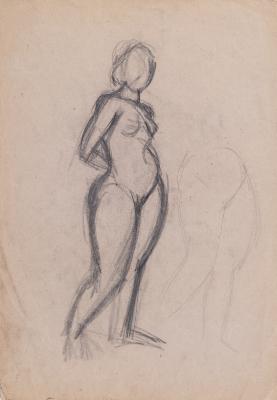
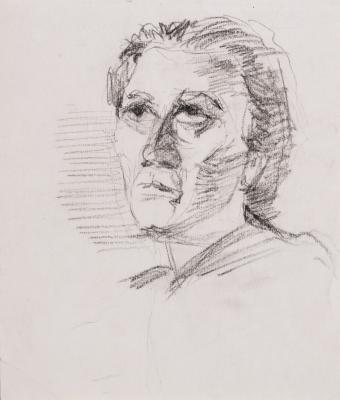
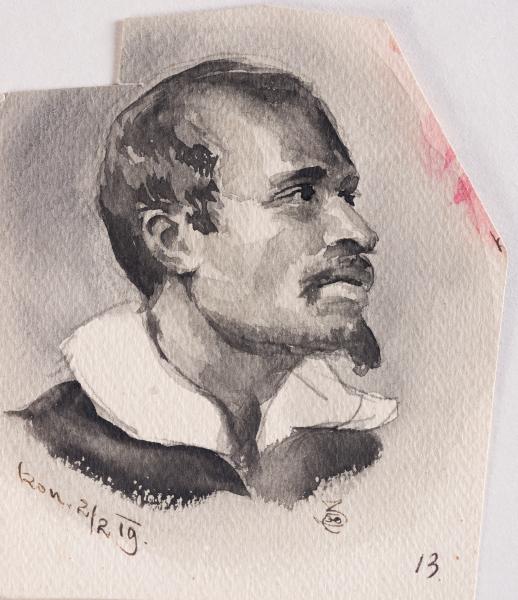
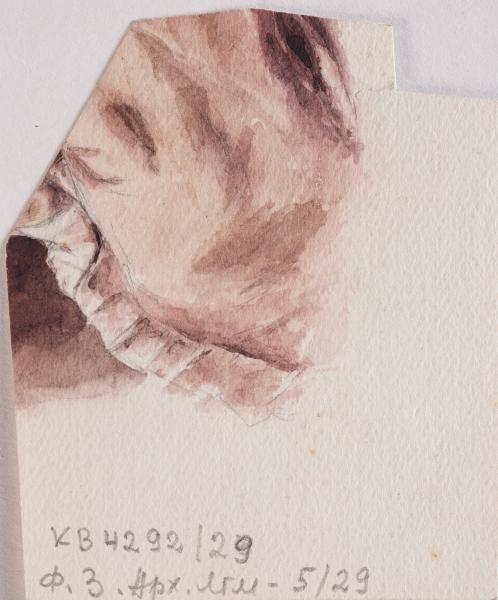
The front side features a portrait of a man, painted in watercolour using a monochrome palette. The portrait is an example of educational copying, a practice in which old masters copied paintings or graphic models, which was common in art education during the late 19th and early 20th centuries. This approach allowed students not only to train their hands but also to master the classical language of form, anatomy, chiaroscuro, and compositional balance. The image is rendered in a bust format with a clearly defined shoulder girdle and a dynamic turn of the head. The model, a bearded man of middle to mature age, is depicted in an expressive, plastic pose, with his chin raised and his gaze directed upward and to the side, which lends the image a touch of inner concentration or spiritual elevation. Such a pose is characteristic of ceremonial or psychologically charged portraits of the Baroque and Classicism periods and may have been borrowed from examples of European painting of the 17th–18th centuries. The tonal modelling is executed with a deep understanding of the volumetric-spatial structure of the form. Skillfully used is the property of the material as a pigment to give a range of halftones and deep shadows: the model's face is rendered with a subtle gradation of transparent layers, and the shadow areas, especially around the eye sockets, under the jaw, and in the hollows of the neck, are reinforced with denser patches of tone. The hair and beard are rendered as decorative graphic spots with local darkening. The blurred edges of the silhouette and the plastically generalised background allow the viewer to focus on the psychology of the image. On the reverse side of the sheet, there are fragments of another work, probably done by the same hand. The image is fragmentary and difficult to define iconographically – it lacks a complete composition or obvious plot clues. It can be assumed that this is an attempt at separate sketch constructions or remnants of a previous sketch that were not implemented in the final composition. Such "reverse" fragments are typical of early 20th-century study sheets, when paper was used sparingly and the reverse side was often used for preliminary exercises or experimental form searches. The work attests to the classical academic training characteristic of the art education system of the time, in which copying was the basis for studying the heritage of the old masters. Working in monochrome watercolour further refined the artist's sense of tonality and depth of form, without the use of colour, which was crucial for the development of the artist's plastic vision.
Inscriptions
On the front side: illegible signature; "2/2 19"; signature of Yulian Zaiats.
Legal regulation
Borys Voznytskyi Lviv National Art Gallery