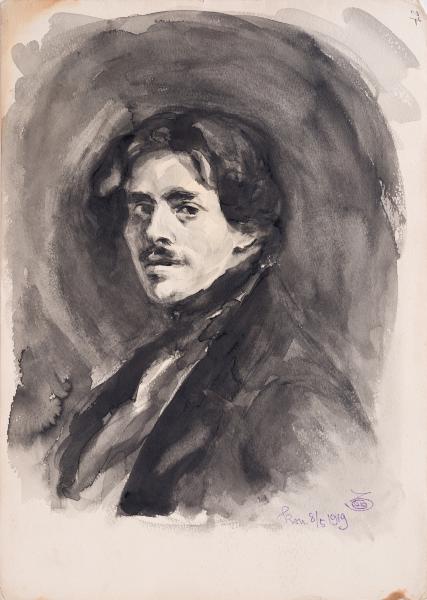
Portrait Drawing of a Young Man
Yulian Zaiats


Basic information
- ID
- Ф-З-Арх-ЛГМ-5/15
- Author
- Yulian Zaiats
- Name
- Portrait Drawing of a Young Man
- Date of creation
- 08.05.1919
- Country
- the Second Polish Republic (?)
- Technique
- watercolour
- Material
- paper watercolour
- Dimensions (height x width, cm)
- 29.6 x 21.2
Additionally
- Type
- painting
- Genre
- portraiture
- Plot
- Portrait
- Provenance
- Received from Nina Zaiats
Information about author
Object description
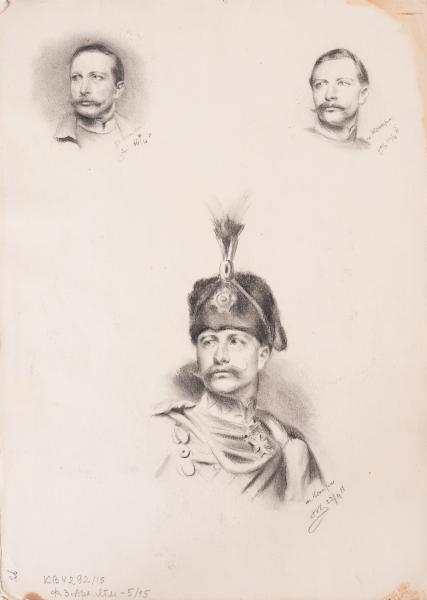
The obverse side features a watercolour copy of Eugène Delacroix's self-portrait, created in 1837. The work is characterised by a subtle modelling of the face using transparent layers of watercolour paint, which allows for preserving the effects characteristic of the original. The composition is presented in a three-quarter view, featuring subtle asymmetry that adds dynamics and psychological depth to the image. Particular attention is paid to the expression of the eyes and the characteristic tilt of the head, which creates an image of the artist as focused, internally collected, and emotionally intense. The artist has preserved the main formal features of the original: the delicate tonal modelling of the face, hair texture, and muted tone in the interpretation of the figure, which is harmoniously coordinated with the background. Although the copy does not replicate the specifics of oil painting, it interprets it through the prism of watercolour technique, which necessitates a different approach to building volume and texture. At the same time, the copy preserves the main thing – the intonation of the image, plastic expressiveness, and individuality of Eugène Delacroix's self-portrait; the general mood is in tune with romanticism. It can be assumed that this watercolour is part of a training cycle or an independent attempt to recreate the expressive means of the great French Romantic in the context of an academic study. On the reverse side of the sheet are three graphic copies of Max Koner's 1891 drawings, which were used as preparatory studies for the portrait of Kaiser Wilhelm II. The compositions are executed in soft pencil with an accurate reproduction of the linear structure of the originals, as well as the rhythm of hatching and contrast characteristic of Max Koner. The centrepiece is a depiction of the Kaiser's head in official military uniform, in front of the Order of St. John. The figure is in a light perspective, with a clearly defined silhouette of the nose, cheekbones, and chin, which emphasises the monumentality of the image and the classical restraint of the composition. Nearby are two additional studies, one without headgear and the other without military insignia. The copies retain the constructive logic of the originals, including the balanced use of chiaroscuro to model volume and precision in expression. These drawings simultaneously serve as an exercise in recreating a historical type and studying the graphic language of German academicism in the late nineteenth century. The nature of their execution demonstrates a deep immersion in the material, an attentive attitude to the stylistic features of the era, and a desire not only to copy but also to comprehend the author's pictorial logic. The letter is a fragment of an educational or independent research project that combined Western European romantic and academic traditions in their French and German manifestations.
Inscriptions
On the front: signature of Yulian Zaiats and the date "8/5 1919". On the reverse: "After Koner"; signature of Yulian Zaiats; "16/4 11". "After Koner"; signature of Yulian Zaiats "16/4/11". "After Koner"; signature of Yulian Zaiats; “22/4 11”.
Portrayed person
- The name of the person portrayed
- Eugene Delacroix (23.04.1798–13.08.1863). On the reverse: Kaiser Wilhelm II (27.01.1859–4.06.1941) (after Max Koner).
Legal regulation
Borys Voznytskyi Lviv National Art Gallery