Crucifixion
unknown


Basic information
- ID
- С-I-1187
- Author
- unknown
- Name
- Crucifixion
- Date of creation
- 18th c.
- Country
- Ukraine
- Technique
- carving polychromy
- Material
- wood
- Dimensions (height x width x depth, cm)
- 58 x 39 x 10
Additionally
- Type
- sculpture
- Genre
- religious
- Plot
- Crucifixion
- Provenance
- Ivano-Frankivsk region
Information about author
Object description
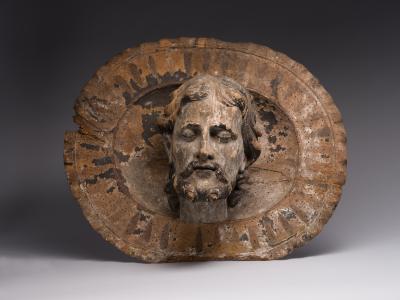
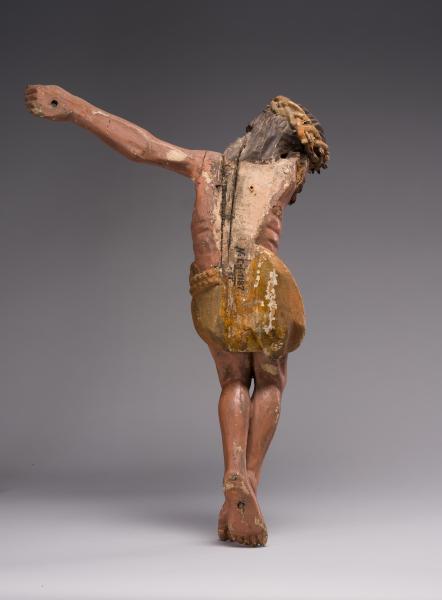
The image of the Crucified Christ was carved by the sculptor in the tradition of Western iconography, featuring expressive artistic elements that lend the image emotional depth. The figure of Christ is depicted at the moment of death, his body leaning to one side, his head bowed to his chest, his eyes closed. Everything in the image emphasises the end of earthly suffering. The plasticity of the body is generalised, but with an eloquent reproduction of the anatomical features of the figure. The tension in the chest, with its textured, carved ribs, and the muscles of the arms and legs are visible. Christ's arms are spread wide (the right arm is missing), in a tense, almost horizontal line; his legs are crossed, creating a dramatic effect and visual rhythm. Despite the dramatic nature of the moment, the image is filled with silence and acceptance. Christ's body is covered at the hips by a perizoma, modelled with soft, voluminous folds that fall naturally downwards. The work is complemented by the restrained pictorial content of the image. The influence of Baroque expression is evident in the curves of the body, the expression on the face, and the tension in the muscles – all designed to evoke empathy.
Legal regulation
Borys Voznytskyi Lviv National Art Gallery