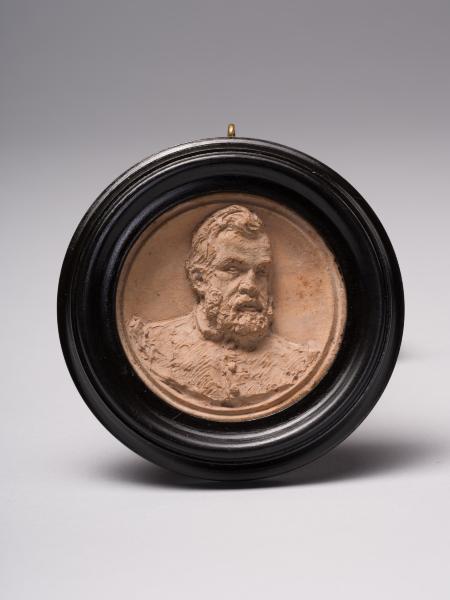
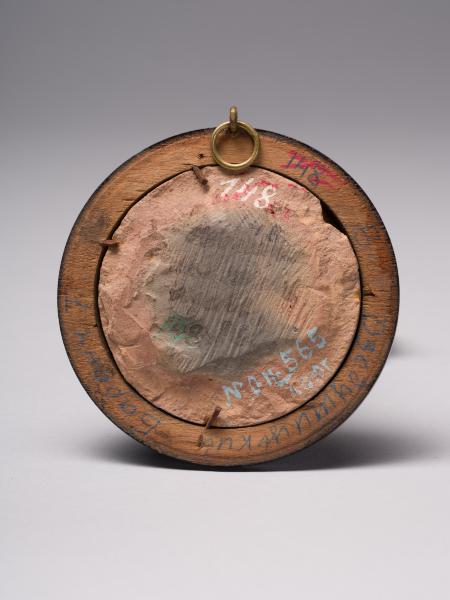
Medal “Wlodzimierz Dzieduszycki”
Tadeusz Baracz


Basic information
- ID
- С-II-565
- Author
- Tadeusz Baracz
- Name
- Medal “Wlodzimierz Dzieduszycki”
- Country
- Austrian Empire Austro-Hungarian Monarchy
- Culture
- Modern times
- Technique
- modeling
- Material
- terracotta
- Dimensions (diameter, cm)
- 6.8
Additionally
- Type
- sculpture (relief)
- Genre
- portraiture
- Plot
- Portrait
- Provenance
- the Dzieduszycki collection
Information about author
Object description
Włodzimierz Dzieduszycki (1825–1899) was a renowned naturalist, ethnologist, archaeologist, collector, founder of the Natural History Museum in Lviv (1870), and patron of the arts. Dzieduszycki was born on June 22, 1825, in Eastern Podolia, in the town of Yaryshiv (Jaryszow) in the Mohyliv district of the Podolia province, into the family of Count Józef Kalasanty Dzieduszycki (1772–1847) and Anna Paulina née Działyńska (Anna Paulina z hr. Działyńskich) (1795–1856), and continued the long-standing magnate family founded by the Ruthenian boyars Dzieduszycki in the 15th century. According to the family genealogical legend, its founder was Vasylko Romanovich, Prince of Novograd-Volynskyi, brother of Danylo Halytskyi. In the 18th century, the Dzieduszycki family became bearers of the count's title and the Sas coat of arms. The family became famous for its scholarship, collecting, educated patronage, and participation in political and cultural life. Włodzimierz was the only and long-awaited son in the family, sickly, shy, and weak in childhood. Nature served as his solace – in the vicinity of Lviv, on his parents' estate in Poturytsia, in contemplation, admiration, and knowledge. His enthusiasm was inspired by his mother, an educated and gifted collector of natural exhibits – shells of tropical molluscs, sea corals, and starfish. She introduced Włodzimierz to natural science, history, and art, and nurtured his love for his home and native land. His intellectual horizons were shaped by folios describing travels, natural science treatises, the estate's atmosphere, and the presence of representatives of noble families, scientists, and artists. The beginnings of his interest in nature were marked by herbaria, snails, beetles, and butterflies caught with a hat, which filled his childhood imagination and rows of cabinets and shelves. Count Dzieduszycki retained his penchant for self-education and solitude in his daily hard work throughout the years. From 1839, the young man was educated by the distinguished teacher Franciszek Kleczkowski. His further education was provided by the renowned ornithologist Ernest Schauer, the founder of the botanical garden of Lviv University; Prof. Jacek Łobarzewski, geographer and local historian Wincenty Pol; Franciszek Stroński, director of the university library in Lviv; scribe and curator of the Ossolineum; and philologist and historian August Bielowski. His education was complemented by travels throughout Europe, attending lectures at German universities, and studying the collections of natural history museums in Paris, Göttingen, Warsaw, and Vienna. After his father's death in 1847, 22-year-old Włodzimierz became the owner of vast “estates” – lands, forests, and manors. He significantly expanded the ornithological collection inherited from Józef Kalasantius and devoted his “work and days” to learning, patronage, collecting, and founding. “Of Ruthenian descent, Polish by nationality” (gente Ruthenus, natione Polonus), Włodzimierz Dzieduszycki was a patriot of the Galician region and contributed to the development of science and the arts there. In November 1858, the count moved the Poturitsky library, inherited from his father, to Lviv, placed it in the palace at 15 Kurkova Street (now 15 Lysenka Street), supplemented it with rare editions, and made it available to readers. Dzieduszycki's “kindred work” was the founding of the Natural History Museum, which was located in the palace on Kurkova Street from 1857 and later in a newly acquired palace on Rutovskogo Street (now Teatralna Street, 18). After the renovation of the building and the arrangement of the exhibition on the second floor, the “Dzieduszycki Museum” was opened for private tours in 1870. From 1873, it was open to the public four times a week, free of charge. On September 10, 1880, Włodzimierz Dzieduszycki handed over the Museum of the Region on the occasion of Emperor Franz Joseph's visit. According to the will, known as the “Poturitskaya Ordinance,” the institution was officially named the “Włodzimierz Natural History Museum” in Lviv. At that time, his collection consisted of about 350,000 museum items. W. Dzieduszycki made a significant contribution to the development of museology by initiating, together with Julian Zacharevych, the project of the City Industrial Museum in Lviv, which was opened to the public in June 1874. Dzieduszycki gained recognition through exhibitions, particularly at the World Exhibition in Vienna (1873), where the count displayed a peasant hut with utensils, pysanky, wood, clay, leather products, and folk costumes. Subsequently, through the efforts of the Galician Economic Society, a similar event was organised in Galicia. W. Dzieduszycki's ethnographic interests were demonstrated at the Paris Exhibition Forum (1878), where Hutsul carpets were presented. After the Paris exhibition, the count gained recognition in Galicia as an expert in exhibition matters. Włodzimierz Dzieduszycki organised the first regional ethnographic exhibition in Kolomyia (1880), where he presented items of folk culture of the Hutsuls, Roma, and Armenians. Włodzimierz Dzieduszycki personally participated in the last General Regional Exhibition in Lviv (1894), which was attended by Emperor Franz Joseph I. The development of education in the region was facilitated by the establishment of craft, industrial, and folk schools by W. Włodzimierz. His desire to create culture was reflected in his patronage, promotion of the development of fine arts, literature, science, and support for scientists, writers, and artists. At the same time, Włodzimierz Dzieduszycki contributed to the publication of scientific works, particularly those of the historian and writer August Bielowski, the renowned Polish ethnologist Oskar Kolberg, and the physicist Wojciech Urbański. In his will, he stipulated that the Natural History Museum should publish four volumes of the fundamental work "Hutsulshchyna" (1897–1908) by the prominent Ukrainian ethnographer Volodymyr Shukhevych. Many years of cooperation connected W. Dzieduszycki with Michał Adam Sozański, as evidenced by numerous letters. Artur Grottger received assistance from the count during his illness. His involvement in artistic life and support for artists is confirmed by his correspondence with Aleksander Gryglewski, Juliusz Kossak, Władysław Łuszczkiewicz, Jan Matejko, and Henryk Rodakowski (Henryk Hipolit Rodakowski). His artistic interests were reflected in a collection that featured paintings by old European masters, collected by Alfonsyna Diduszycka's grandfather, Ignacy Miączyński, alongside works by contemporary Polish artists. Located in the palace at 15 Kurkowa Street and opened to the public in 1909, the collection included works by Artur Grottger, Juliusz Kossak, Jan Matejko, Józef and Alojzy Rejchan, Henryk Rodakowski, Michał Adam Sozański, Franciszek and Bruno Tep, Józef Chełmoński, and Józef Chojnicki. In total, including inherited items, there are over 3,000 graphic sheets and 850 paintings. The numismatic collection of W. Dzieduszycki, inherited from Józef Kalasanti and significantly expanded, numbered over 3,000 artefacts at the end of the 19th century. It included medals and coins from the 11th to the 19th centuries and was one of the most conceptual in Galicia.
Portrayed person
- The name of the person portrayed
- Wlodzimierz Dzieduszycki
- Lifetime of the person portrayed
- 1825–1899
Legal regulation
Borys Voznytskyi Lviv National Art Gallery