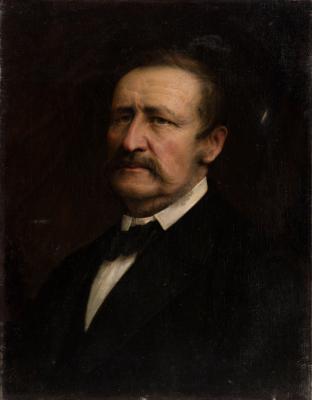
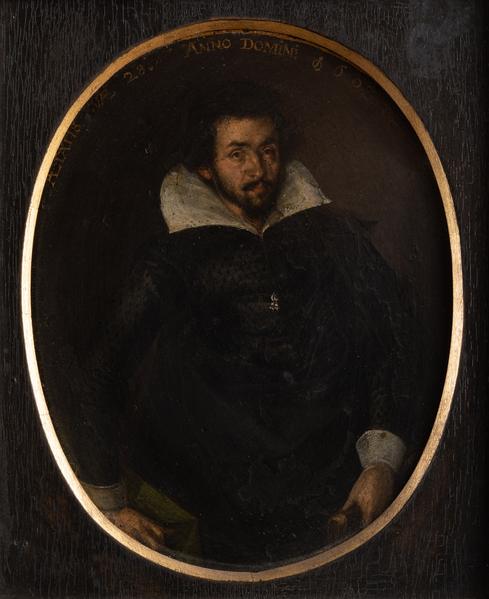
Male Portrait (Portrait of Rafal Leszczynski ?)
unknown, unknown (Workshop of Frans Pourbus the Younger)


Basic information
- ID
- Ж-505
- Author
- unknown unknown (Workshop of Frans Pourbus the Younger)
- Name
- Male Portrait (Portrait of Rafal Leszczynski ?)
- Date of creation
- 2d half of the 18th c.
- Country
- Spain
- Technique
- oil painting
- Material
- copper oil
- Dimensions (height x width, cm)
- 15.5 x 12
Additionally
- Type
- painting
- Genre
- portraiture
- Plot
- Portrait
- Provenance
- Collection of Leon Pininski
- Exposition
- Potocki Palace
Information about author
Information about author
Object description
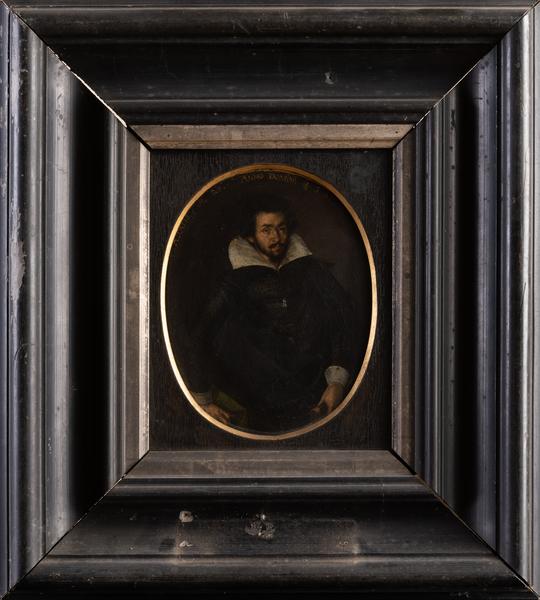
The miniature portrait from Leon Pininski's collection depicts a man in a fashionable Italian-French suit against an olive background. The man has thick black hair, a moustache, and a beard. He wears a dark camisole with a wide white collar and white cuffs. With his right hand, the portrayed leans on the edge of a table while holding a book in his left hand. The artwork was painted on copper, and according to the Latin inscription, the man was 28 years old in 1607. The style of this painting resembles the miniature portrait of an unknown man (c. 1600) preserved in the Victoria and Albert Museum, painted on copper and attributed to a Flemish artist, as well as the miniature portrait of an unknown man (1614) in the Amsterdam State Museum, also painted on copper and attributed to a Dutch artist. As Marcin Latka, an independent art researcher, notes in his https://artinpoland.weebly.com/en/forgotten-portraits-of-the-polish-vasas-part-i-1587-1623">publication</a>, the portrait might belong to the workshop of Frans Pourbus the Younger, who served as a court painter to Duke Vincenzo Gonzaga in Mantua from October 1600. Additionally, he visited Innsbruck, Turin, Paris, and Naples, and in 1609, Queen Marie de' Medici summoned him to Paris as a court painter. Frans and his workshop also took commissions from abroad without personally meeting the customers. This portrait is of Rafal Leszczynski, castellan of Lublin, born in October 1579. He was the only son of Andrzej Leszczynski, Kuyavian voivode, and Anna Firlej, the daughter of Andrzej Firlej. Rafal had three stepbrothers: Jan, the Grand Chancellor of the Crown; Waclaw, the Primate of Poland; and Przeclaw, the voivode of Tartu. Rafal Leszczynski was the great-grandfather of King Stanislaw Leszczynski. In 1607, Rafal Leszczynski, who inherited the estate from his father, could have commissioned a series of portraits of himself and his family in Italy. It is possible that an artist from Frans Pourbus's workshop was present in Poland then.
Inscriptions
At the top, there is an inscription: "Aetatio mae 28 Anno Domini 1607"
Portrayed person
- The name of the person portrayed
- Rafal Leszczynski (?)
- Lifetime of the person portrayed
- 1579–1636
Legal regulation
Borys Voznytskyi Lviv National Art Gallery