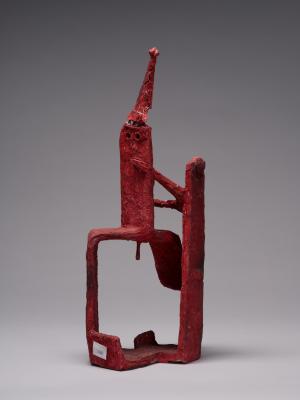
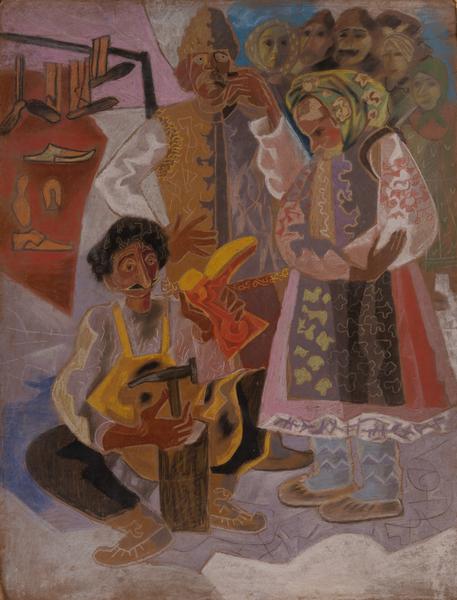
Sketch for a Mural on the Territory of the Lviv State Leather Enterprise (until 1976, the Svitanok Leather Company)
Vasyl Poliovyi


Basic information
- ID
- Г-II-332
- Author
- Vasyl Poliovyi
- Name
- Sketch for a Mural on the Territory of the Lviv State Leather Enterprise (until 1976, the Svitanok Leather Company)
- Date of creation
- 1970s (?)
- Country
- the USSR
- Culture
- Ukrainian art of the Soviet period
- Technique
- mixed technique
- Material
- cardboard pastel
- Dimensions (height x width, cm)
- 109.5 x 84
Additionally
- Type
- graphic art
- Genre
- symbolic art
- Provenance
- Handed over to the museum from Vasyl Poliovyi
Information about author
Object description
The work belongs to the sketches for the Lviv Leather Enterprise (1980). Now the sketches are lost. As in the scene at the fair (Г-ІІ-340), the interpretation used by the artist is relatively realistic, and the nature of the detail is more illustrative than monumental. As a result, a rather uncommon use of textures imitating ornamentation (on a sleeveless fur vest (keptar), headscarf, shirt, outerwear, and shoes) can be observed. This approach adds an ethnographic component to the artwork while complicating the possibility of identification, thus contributing to the simultaneous universalisation of the images. The sketch depicts a scene in a shoemaker's workshop, where customers have arrived: a man (shown facing the viewer, holding a pipe in his left hand) and a woman (figure shown in a three-quarter view, face in profile), both dressed in national costumes (stylised decoratively, corresponding to the transitional seasons), positioned in the centre and on the right side of the composition. The craftsman is sitting to their left, wearing casual clothes and a yellow work apron. He holds a shoemaker's hammer in his right hand, turned in the most recognisable profile angle, and in his left hand, he holds a finished ornamented leather boot – sapianets. Behind his back, on the left side of the wall, shoe lasts for boots and traditional woven shoes (postoly) are hanging, as well as other tools. In the middle of the artwork, on the right side, as if entering the studio from the street, there is a stylised group of people: three women, two men, and one unidentified person. It is difficult to state the time of the event because, despite the traditional costumes and archaic instruments used by the artist, in certain regions, such a scene could be observed both in the nineteenth century and in the 1970s. The colour scheme is harmonious and balanced, with cold tones predominating. The main accent is in the centre of the composition – a red leather boot (sapianets) with a bright yellow sole.
Legal regulation
Borys Voznytskyi Lviv National Art Gallery