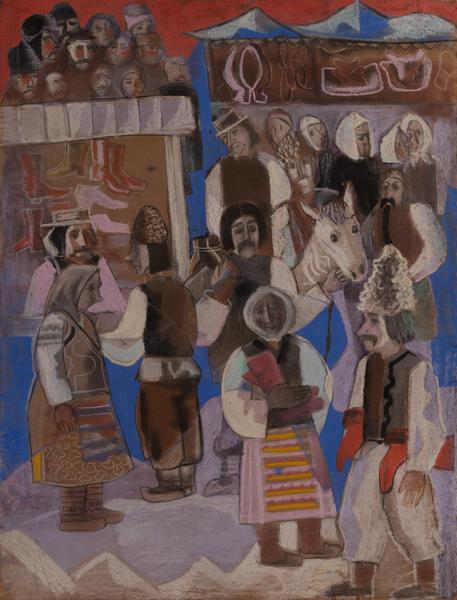
Sketch for a Mural on the Territory of the Lviv State Leather Enterprise (until 1976, the Svitanok Leather Company)
Vasyl Poliovyi



Basic information
- ID
- Г-II-340
- Author
- Vasyl Poliovyi
- Name
- Sketch for a Mural on the Territory of the Lviv State Leather Enterprise (until 1976, the Svitanok Leather Company)
- Date of creation
- 1970s (?)
- Country
- the USSR
- Culture
- Ukrainian art of the Soviet period
- Technique
- mixed technique
- Material
- cardboard pastel
- Dimensions (height x width, cm)
- 109.5 x 83.5
Additionally
- Type
- graphic art
- Genre
- symbolic art
- Provenance
- Handed over to the museum from Vasyl Poliovyi
Information about author
Object description
The sketch belongs to a series executed in the Lviv Leather Enterprise murals (1980). Today, the artworks are lost. This piece is dedicated to recounting the history of leather production, not only in the context of skin processing and obtaining the final raw material – in this case, the viewer can also discover what range of consumer goods were made from these materials until recently. A scene unfolds at a fair where craftsmen sell saddles, yokes, bridles and other parts of horse harnesses, and women's and men's footwear (red boots) for casual and festive occasions. The seasonality of the characters' clothing and the types of shoes purchased indicate that this takes place before a religious holiday in spring or autumn. The fair assumingly takes place in the Hutsul region (a woman in the foreground wears a characteristic orange zapaska – a Hutsul rectangular apron, and several men wear distinctive bryls – male straw hats, and postoly – traditional leather shoes). However, it could be another ethnographic region (the tall fur hats resembling kuchma style are more typical of areas bordering Moldova). Unlike most other mural sketches, the figures of all the characters are more realistic; the colour scheme is cold (ultramarine, cold earthy shades, and whitened purple), with minor warm accents (red and orange). The composition is arranged in several perspectives: in the foreground, a man and a woman on the right side are walking, having just bought a pair of sapiantsi – ankle leather boots. In the left part, further away, a man and a woman are standing next to a footwear stall; the man is actively communicating with the craftsman-vendor. Slightly further back on the artwork's right side, another man is leading a horse he bought a leather collar for. There is a stall with horse tack at a distance, and three men and five women are standing close by, their backs to the counter. A large group of men and women is depicted in the far right corner of the composition. The viewer can only see their heads: some faces on the right side are blurry, and presented rather decoratively. Six of the characters have vibrant, as if tinted, red cheeks. This focus on detail is significant because in the practice of Bukovinians, particularly during the Krasnoilsk Malanka festival, there was a tradition of painting the participants' faces this way, regardless of gender. However, the latter is difficult to assert given the relatively light clothing of other characters for this season, although the presence of certain headwear styles characteristic of the region also suggests that the scene may not take place in the Hutsul region.
Legal regulation
Borys Voznytskyi Lviv National Art Gallery