Pharisee
unknown (Austrian School)


Basic information
- ID
- С-I-350
- Author
- unknown (Austrian School)
- Name
- Pharisee
- Date of creation
- 18th c.
- Country
- Ukraine
- Technique
- carving polychrome
- Material
- wood
- Dimensions (height x width x depth, cm)
- 48 x 18.5 x 11
Additionally
- Type
- sculpture
- Genre
- religious
- Plot
- Pharisee
- Provenance
- Collection of Leon Pininski
Information about author
Object description
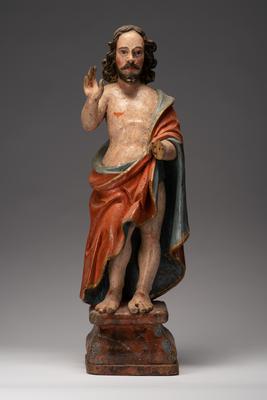
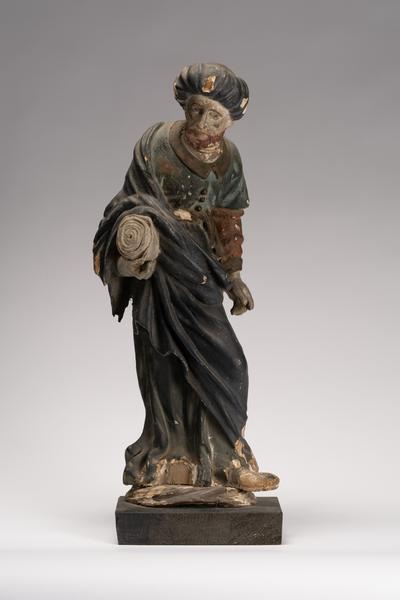
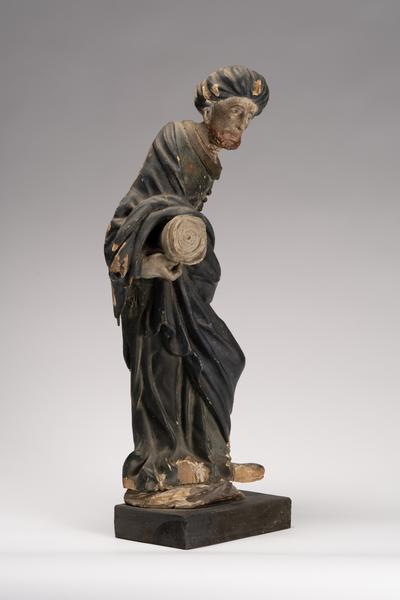
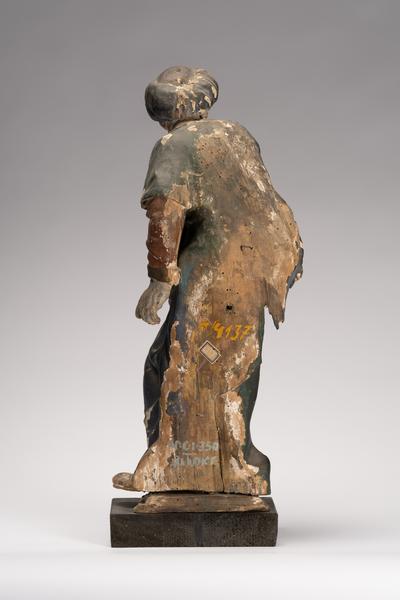
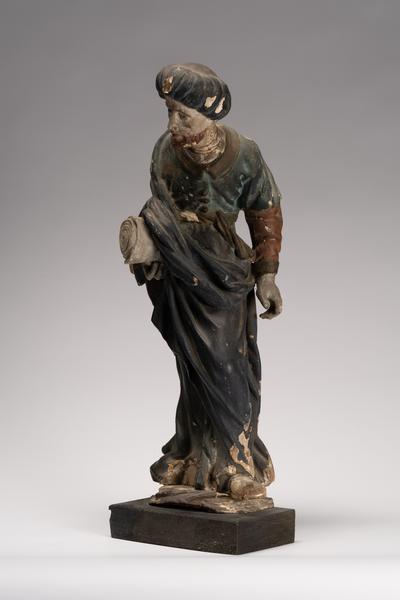
The Pharisees are a religious movement whose followers strictly observed numerous rites of the Law, as well as those invented by themselves, to demonstrate ostentatious sanctity, despite the fact they secretly sinned. A full-length figure of a Pharisee is placed on the low square stand. His left leg is put forward; a large bundle is in his right hand. A man's garment covers his entire body, leaving only his hands and feet open (according to the Gospels, the Pharisees stood out from the crowd by elongated garments; also, they wore headbands on their forehead and hands, where they could write down quotations from the Bible). The man is wearing a turban, and a dark cloth is wrapped around his head that is turned to the right shoulder. There is a drapery over his garment. Falling from the right shoulder, it wraps around the lower part of the figure and covers the man's arm. Its surface is modelled by soft folds, which fall down slowly with diagonal strands. The shallow deepening of straight lines makes the slow dynamism of draperies. The static sculpture of the Pharisee is full of peace. His elongated face with sunken cheeks, a long nose, and small eyes show an expression of indifference and ostentatious sanctity.
Legal regulation
Borys Voznytskyi Lviv National Art Gallery