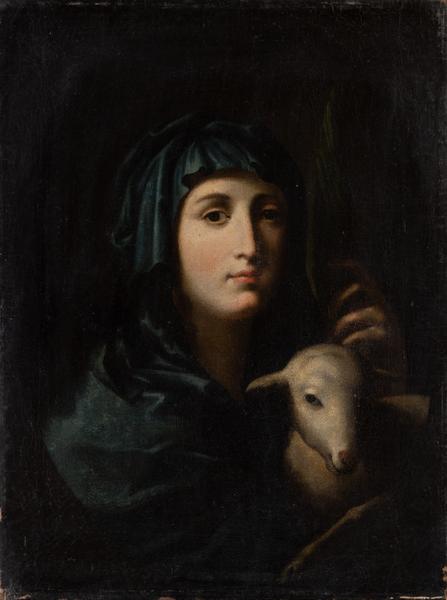
Saint Agnes with a Lamb
unknown (Italian School), unknown (German School)



Basic information
- ID
- Ж-99
- Author
- unknown (Italian School) unknown (German School)
- Name
- Saint Agnes with a Lamb
- Date of creation
- 16th–18th c.
- Technique
- oil painting
- Material
- duplicated canvas oil
- Dimensions (height x width, cm)
- 63.5 x 48
Additionally
- Type
- painting
- Genre
- religious
- Provenance
- Collection of Lviv City Gallery
- Exposition
- Potocki Palace
Information about author
Information about author
Object description
The painting portrays a young woman looking confidently at the viewer. She is depicted as Agnes, the patron saint of young girls and maidens, with her characteristic attributes: a lamb (a symbol of her virtuous innocence and Christian devotion) and a palm branch. Her name means "chaste" in Greek, but it is also associated with a lamb – the saint was betrothed to Christ, the Lamb of God. That is why Agnes is depicted with a lamb. The iconography of Saint Agnes also presents her with two crowns, symbolising chastity and martyrdom. In addition, her attributes included ivory, an oil lamp, a lily, a sword, and a scroll. There is limited reliable historical information about the life and martyrdom of Agnes of Rome. However, it is known that she died by the sword during the reign of Diocletian. Saint Ambrose and Saint Jerome, Saint Pope Damasus, Saint Gregory the Great, and many others mentioned her pure and courageous faith testimony. According to tradition, Agnes was about to be married to a wealthy Roman young man, but she refused, saying that she had found a husband whom earthly eyes could not see. To intimidate Agnes, the suitor for her hand in marriage revealed that she was a Christian. The saint was condemned to death and was about to be burned at the stake. This attempt failed, and she was eventually beheaded.
Legal regulation
Borys Voznytskyi Lviv National Art Gallery