Back

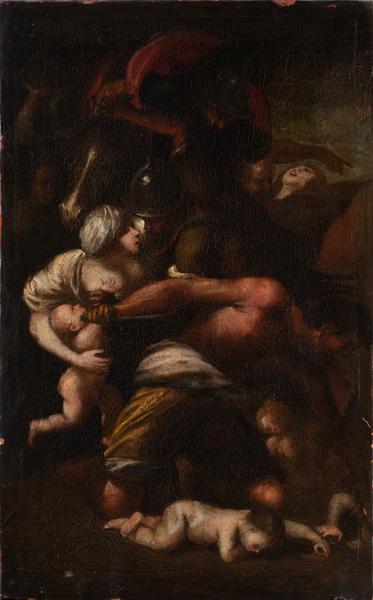
Massacre of the Innocents

Federico Cervelli

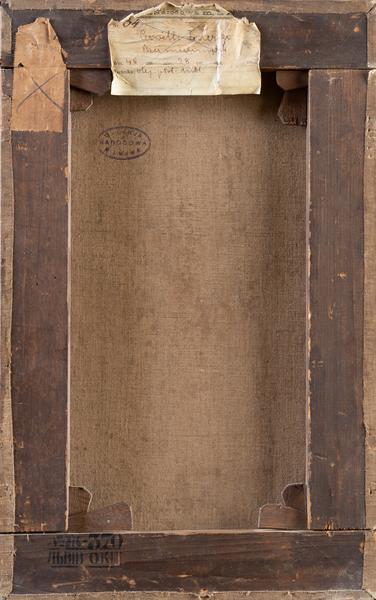
  • Massacre of the Innocents 2
  • Massacre of the Innocents 3
Basic information
ID
Ж-370
Author
Federico Cervelli
Name
Massacre of the Innocents
Date of creation
17th c.
Technique
oil painting
Material
canvas oil
Dimensions (height x width, cm)
45 x 28
Information about author
Author
Federico Cervelli
Artist's lifetime
1638 – c.1700
Country
Italy
Biography
Federico Cervelli was born in 1638 in Milan. As a young man, he arrived in Venice and, according to some sources, joined the school of the renowned artist of that time, Pietro Liberi. The painter's date of birth was traditionally considered 1625, but now, referring to studies, Cervelli's year of birth is 1638. Thus, the first half of the master's artistic practice in Venice took place between 1655 and 1660, the time of Liberi's painting career. There is no information about the author's youth or his studies. Critics know little about the artist's personality. Still, it is known that he was famous in his time: he was recognised by Marco Boschini, who even mentioned Cervelli to Cardinal Leopoldo de' Medici. Federico Cervelli was also known as the founder of an art school that trained famous artists such as Sebastiano Ricci. Very little is known about Cervelli's artistic activity; only a few of his artworks are recognised today. The first known work, "Magdalene" (1668), has disappeared. A significant group of paintings by the master consisting of five canvases with mythological subjects is preserved in the Querini Stampalia Foundation in Venice. The artworks are undated but stylistically very consistent. The master's works also include: "Sacrifice of Noah" (1678) from the Santa Maria Maggiore Church in Bergamo; three canvases with allegorical figures of Prudence, Fear and Wisdom on the ceiling of the former Scuola Grande di San Marco in Venice (1683); "Massacre of Innocents" (1688) from the San Giorgio Monastery in Venice. It is challenging to establish a chronological sequence of the artist's career and therefore trace the stylistic development of his work. Some paintings are undoubtedly stylistically close to the manner of Pietro Liberi's late paintings. They also share similarities in the typology of characters, distribution, and characteristic softness of brushwork. It can be assumed that Cervelli, who arrived in Venice and entered Liberi's studio, was initially influenced by him, following his artistic manner. However, later on, he might have gradually separated himself from his teacher's style and continuously searched for a more expansive, in a sense, classical style of painting. Cervelli adhered to the trends of the young artistic generation working in Venice during the last two decades of the seventeenth century, representing a distinctive intermediate stage between their "Baroque" language and the manner that paved the way to the eighteenth century. Federico Cervelli passed away in Venice around the year 1700.
Object description
The idea behind creating this painting was the story from the Gospel of Matthew about King Herod's order to slaughter infants in Bethlehem and its surroundings. Many Renaissance artists, including Valerio Castello, Pieter Bruegel, Nicolas Poussin, and Rubens, depicted this story in their paintings. On the canvas, the artist shows a cruel, macabre scene with strong contrasts of light and shadow. The canvas is dominated by dark, deep shades of green and brown. The plot is depicted dynamically. In the foreground, a half-naked man on his knees, who withdraws his hand with a sword in an attempt to kill the infant, is depicted. Behind him is the figure of a warrior pulling the child from the arms of its frightened mother. Above, in the background, is the silhouette of a warrior on horseback, with the image of the grieving mother's face under his left arm.
Legal regulation
Borys Voznytskyi Lviv National Art Gallery