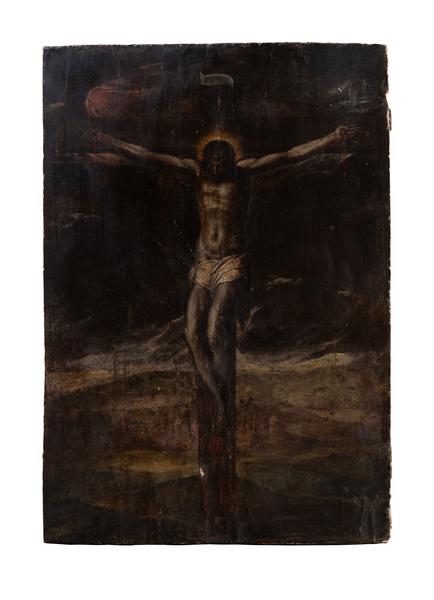
Crucifixion
unknown (Copy after Anthony van Dyck)


Basic information
- ID
- Ж-1925
- Author
- unknown (Copy after Anthony van Dyck)
- Name
- Crucifixion
- Technique
- oil painting
- Material
- wood oil
- Dimensions (height x width, cm)
- 55 x 38.5
Additionally
- Type
- painting icon
- Genre
- religious
- Plot
- Crucifixion
- Provenance
- Collection of Ukrainian National Museum in Lviv
- Exposition
- Potocki Palace
Information about author
Object description
Visually, this painting appears simple, but the depiction is thoughtfully executed, indicating the artist's understanding of its purpose and place. First and foremost, the viewer is presented with the figure of Jesus on the cross, the iconographic symbol of Christianity. We know what this represents and how we should react – with sorrow, grief, empathy, and piety. However, this scene is not set against heavenly gold, as we commonly see in art. Instead, the crucified Jesus is immersed in darkness. No people or familiar biblical characters are portrayed here, as is usually depicted in this theme. The witness is only the viewer, forced to confront the scene face-to-face. Without the depiction of anguished, grief-stricken faces and excessive realism of the dead body, the power of this painting lies in its potential for the viewer's spirituality. Jesus's death is reflected in the darkness of this painting, but it is a death with hope. The canvas background features a landscape with hills and a barely visible city. The sky, occupying most of the background, is covered in dark clouds. At the centre of the composition, filling nearly the entire plane of the painting, is the Crucifixion. On the cross of dark wood is the body of the dead Christ. His head is down, illuminated by the halo's light. Blood flows from Christ's wounds. Above his head is a plaque with the inscription: "I.N.R.I." – "Jesus the Nazarene, King of the Jews". According to the Gospel of John, this phrase was written by Pontius Pilate on the cross. Above both hands of Christ, there are two images in the upper part of the canvas – the moon and the sun. The moon, a symbol of the Old Testament, is above the left hand. Above the right hand is the sun, a symbol of the New Testament. This image can be interpreted as the conclusion of the Old Testament after the sacrificial death of Jesus Christ. The original "Crucifixion" created between 1628 and 1630 (133 x 101) is preserved in the Museum of Art History in Vienna.
Legal regulation
Borys Voznytskyi Lviv National Art Gallery