"The Passion of Christ" Iconostasis: The Denial of Peter the Apostle, The Flagellation of Christ
unknown


Basic information
- ID
- Ж-4130
- Author
- unknown
- Name
- "The Passion of Christ" Iconostasis: The Denial of Peter the Apostle, The Flagellation of Christ
- Date of creation
- early 18th c.
- Country
- Ukraine
- Culture
- Rybotytska School
- Technique
- tempera painting
- Material
- wood tempera
- Dimensions (height x width, cm)
- 108.5 x 78.5
Additionally
- Type
- icon
- Genre
- religious
- Plot
- The Passion of Christ
- Provenance
- Semenivka village, Lviv region
Information about author
Object description
"The Passion of Christ" is an iconostasis of the 17th – early 18th century consisting of a series of monumental multi-plot icons that should be viewed from top to bottom, in rows from left to right. The work's composition is distinguished by a large number of iconographic images with multi-figure scenes: 25 horizontally elongated Gospel scenes that tell us about the last days of Christ's earthly life. The work was created by a painter who followed the traditions of the Rybotytska School of icon painting. The village of Rybotychi was one of the most famous centres of folk iconography in the seventeenth and eighteenth centuries. The works of the masters of this centre were known far beyond its borders. The theme of the Passion of Christ was common in their work. However, the canonical framework of the Gospel narratives became too tight for icon painters. Therefore, they often supplemented their works with folk legends, beliefs, and apocryphal stories.
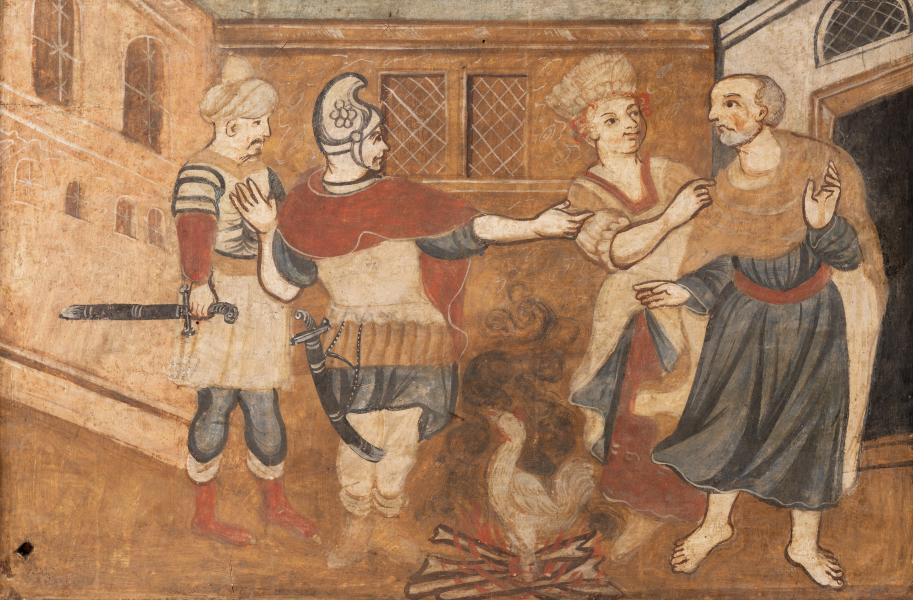
Two images depict the "Denial of Peter the Apostle" and "Flagellation of Christ" scenes. They attract the viewers' attention with their simplicity, immediacy and expressiveness, and the artist's attention to detail. "The Denial of Peter the Apostle" is a New Testament story describing an event Jesus predicted. During the Last Supper, Peter the Apostle betrayed Christ, and after His arrest, he denied his Master three times. When the rooster crowed, Peter remembered Jesus' words and repented. Painters attached particular importance to this story, often emphasising the characteristic detail – the rooster image, which can be seen in this iconographic composition. In laconic and figurative language, the artist managed to depict a dramatic plot with a balanced composition, in the colouristic solution of which warm colours dominate.
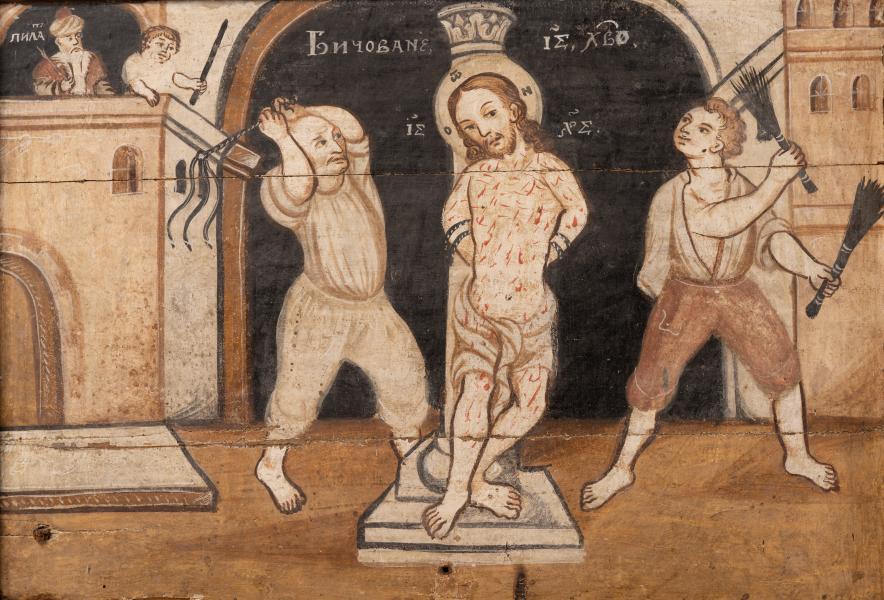
The "Flagellation of Christ" iconographic plot is reproduced against the generalised architectural background. The master depicted the plot as a genre scene. The centre of the composition is the full-length figure of Jesus, tied to a pillar. His wounded body, tortured by whipping, is covered with abundant drops of blood, and his head is tilted to the right shoulder and illuminated by a halo. The image of the Saviour is full of submission and humility. A biblical character can be seen on the balcony of the house, which the inscription on the work can identify. Working on the icons, the artist sought to reveal people's characters and convey the tension of iconographic subjects.
Two images depict the "Denial of Peter the Apostle" and "Flagellation of Christ" scenes. They attract the viewers' attention with their simplicity, immediacy and expressiveness, and the artist's attention to detail. "The Denial of Peter the Apostle" is a New Testament story describing an event Jesus predicted. During the Last Supper, Peter the Apostle betrayed Christ, and after His arrest, he denied his Master three times. When the rooster crowed, Peter remembered Jesus' words and repented. Painters attached particular importance to this story, often emphasising the characteristic detail – the rooster image, which can be seen in this iconographic composition. In laconic and figurative language, the artist managed to depict a dramatic plot with a balanced composition, in the colouristic solution of which warm colours dominate.
The "Flagellation of Christ" iconographic plot is reproduced against the generalised architectural background. The master depicted the plot as a genre scene. The centre of the composition is the full-length figure of Jesus, tied to a pillar. His wounded body, tortured by whipping, is covered with abundant drops of blood, and his head is tilted to the right shoulder and illuminated by a halo. The image of the Saviour is full of submission and humility. A biblical character can be seen on the balcony of the house, which the inscription on the work can identify. Working on the icons, the artist sought to reveal people's characters and convey the tension of iconographic subjects.
Legal regulation
Borys Voznytskyi Lviv National Art Gallery