"The Passion of Christ" Iconostasis: The Arrest of Christ, Pilate's Court, Pilate Washing His Hands, The Pharisees Shout to Crucify Christ
unknown




Basic information
- ID
- Ж-4131
- Author
- unknown
- Name
- "The Passion of Christ" Iconostasis: The Arrest of Christ, Pilate's Court, Pilate Washing His Hands, The Pharisees Shout to Crucify Christ
- Date of creation
- early 18th c.
- Country
- Ukraine
- Culture
- Rybotytska School
- Technique
- tempera painting
- Material
- wood tempera
- Dimensions (height x width, cm)
- 117 x 160
Additionally
- Type
- icon
- Genre
- religious
- Plot
- The Passion of Christ
- Provenance
- Semenivka village, Lviv region
Information about author
Object description
"The Passion of Christ" is an iconostasis of the 17th – early 18th century consisting of a series of monumental multi-plot icons that should be viewed from top to bottom, in rows from left to right. The work's composition is distinguished by a large number of iconographic images with multi-figure scenes: 25 horizontally elongated Gospel scenes that tell us about the last days of Christ's earthly life. Often, in the works by the Rybotytska School masters, these plots were intertwined with legends and apocryphal stories. Such a pictorial interpretation was accessible to all social categories of the population, especially to the illiterate, who were the most numerous.
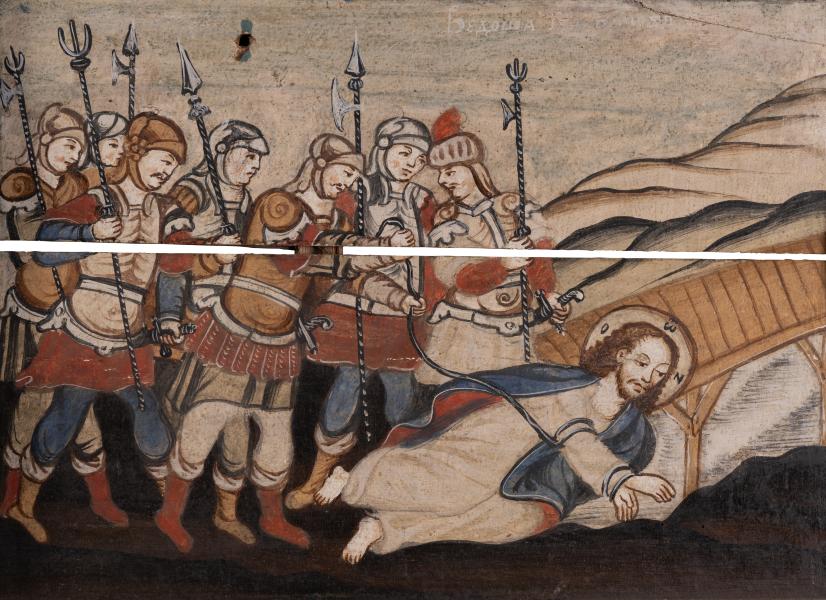
One of the images depicts the episode of Christ's arrest. The event occurs in the Garden of Gethsemane: the guards tie Jesus up and take him to the court of the chief priests. The author used a precise, expressive contour, depicting a group of guards dressed as Roman soldiers against the background of a mountainous landscape. The scene is characterised by compositional harmony and colouristic balance.
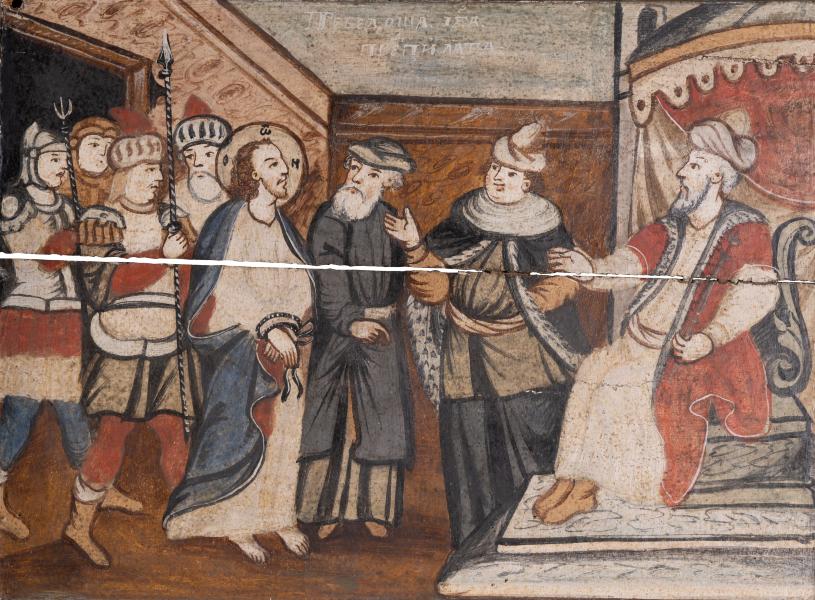
The other three images are related to the last trial of the Saviour, which was conducted by the Roman governor of Judea, Pontius Pilate. The artist depicted a scene when the Jewish chief priests and guards brought the bound Saviour to Pilate's court to have him sentenced to death. The main character in the story is Christ, who is the focus of everyone's attention. The squat figures with a clear graphic contour line are depicted flatly and in warm colours. After taking water and washing his hands, Pilate declared in front of everyone: "I am innocent of this Man's blood; see to that yourselves..." (Matthew 27:24). It was this scene that the icon painter conveyed, depicting a significant number of everyday details. "Ecce Homo" is a well-known scene in Western European art that visualises the suffering of the Messiah, highlighted in the work from the village of Semenivka. Christ is depicted wearing a crown of thorns, bloody after being scourged, with a red cloak on His shoulders. Despite the abuse, the frontal image of the Saviour remains solemn and balanced, unlike his executioners, depicted in profile, which in the language of symbols of ancient iconography was a sign of contempt. A dark graphic contour characterises the work; the eyes of the characters are expressive, with an emphasis on the pupils, and active blushes are visible on the bleached faces. The scenes of the Passion of Christ attract attention with their simplicity, immediacy, expressiveness of the drawing, and detailed reproduction of everyday things.
One of the images depicts the episode of Christ's arrest. The event occurs in the Garden of Gethsemane: the guards tie Jesus up and take him to the court of the chief priests. The author used a precise, expressive contour, depicting a group of guards dressed as Roman soldiers against the background of a mountainous landscape. The scene is characterised by compositional harmony and colouristic balance.
The other three images are related to the last trial of the Saviour, which was conducted by the Roman governor of Judea, Pontius Pilate. The artist depicted a scene when the Jewish chief priests and guards brought the bound Saviour to Pilate's court to have him sentenced to death. The main character in the story is Christ, who is the focus of everyone's attention. The squat figures with a clear graphic contour line are depicted flatly and in warm colours. After taking water and washing his hands, Pilate declared in front of everyone: "I am innocent of this Man's blood; see to that yourselves..." (Matthew 27:24). It was this scene that the icon painter conveyed, depicting a significant number of everyday details. "Ecce Homo" is a well-known scene in Western European art that visualises the suffering of the Messiah, highlighted in the work from the village of Semenivka. Christ is depicted wearing a crown of thorns, bloody after being scourged, with a red cloak on His shoulders. Despite the abuse, the frontal image of the Saviour remains solemn and balanced, unlike his executioners, depicted in profile, which in the language of symbols of ancient iconography was a sign of contempt. A dark graphic contour characterises the work; the eyes of the characters are expressive, with an emphasis on the pupils, and active blushes are visible on the bleached faces. The scenes of the Passion of Christ attract attention with their simplicity, immediacy, expressiveness of the drawing, and detailed reproduction of everyday things.
Legal regulation
Borys Voznytskyi Lviv National Art Gallery