Exiled to Siberia
Witold Pruszkowski


Basic information
- ID
- Ж-3388
- Author
- Witold Pruszkowski
- Name
- Exiled to Siberia
- Date of creation
- 1893
- Country
- Austro-Hungarian Empire
- Technique
- oil painting
- Material
- canvas oil
- Dimensions (height x width, cm)
- 115 x 183
Additionally
- Type
- painting
- Genre
- history painting symbolic art
- Provenance
- Lviv Historical Museum
Information about author
Object description
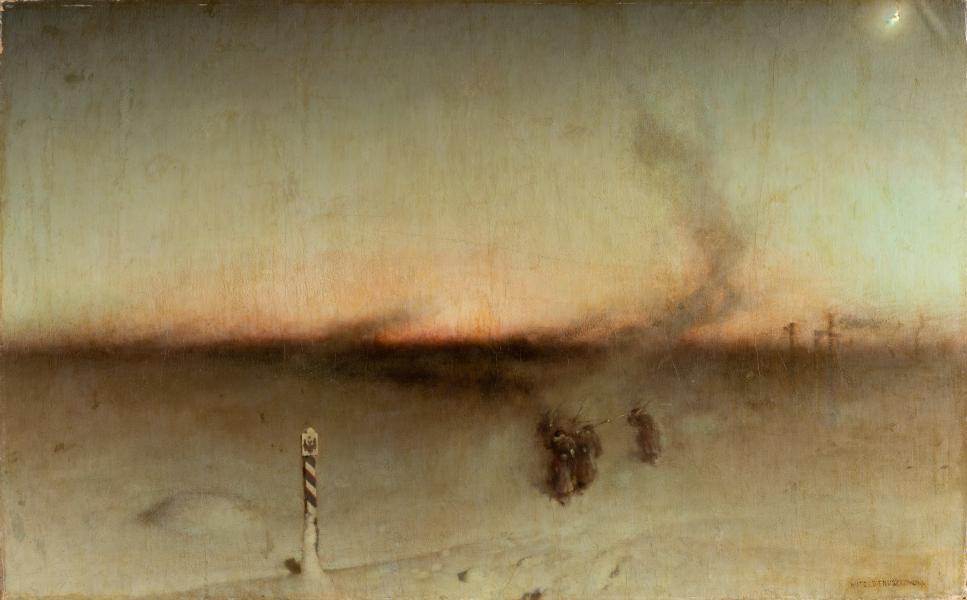
The work of the first Polish symbolist, Witold Pruszkowski, was based on the romantic tradition with its idealistic attitude towards life and death. The creativity of the outstanding poet and playwright Juliusz Slowacki (1809–1849) had a tremendous influence on the artist. The poem "Anhelli" (1838), dedicated to the Polish insurgents sentenced to exile in Siberia, inspired many artists of that time. In addition to W. Pruszkowski, Arthur Grottger and Jacek Malczewski addressed the Siberian theme. One of Witold Pruszkowski's most famous paintings on this theme is titled "Exiled to Siberia". The painting depicts the snowy expanses of Siberia. In the foreground to the left is a border post with the imperial coat of arms. In the endless silence, Polish exiles walk as if heading to another world. The wind of the snowstorm blurs the horizon, merging the earth with the sky. High in the sky, a star shines indifferently with a cold light. On the right, crosses can be seen marking the place where their predecessors fell – those who could not endure the long, arduous journey and did not reach their destination.
Inscriptions
In the lower right, the author's signature: "Witold Pruszkowski".
Legal regulation
Borys Voznytskyi Lviv National Art Gallery