Magic Room 7x7
Ihor Podolchak


Basic information
- ID
- Г-IV-5824
- Author
- Ihor Podolchak
- Name
- Magic Room 7x7
- Date of creation
- 1991
- Technique
- etching aquatint embossing
- Material
- paper
- Dimensions (height x width, cm)
- 35 x 57
Additionally
- Type
- graphic art
- Provenance
- Gifted by Ihor Podolchak
Information about author
Object description
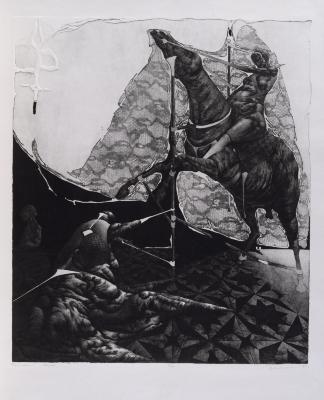
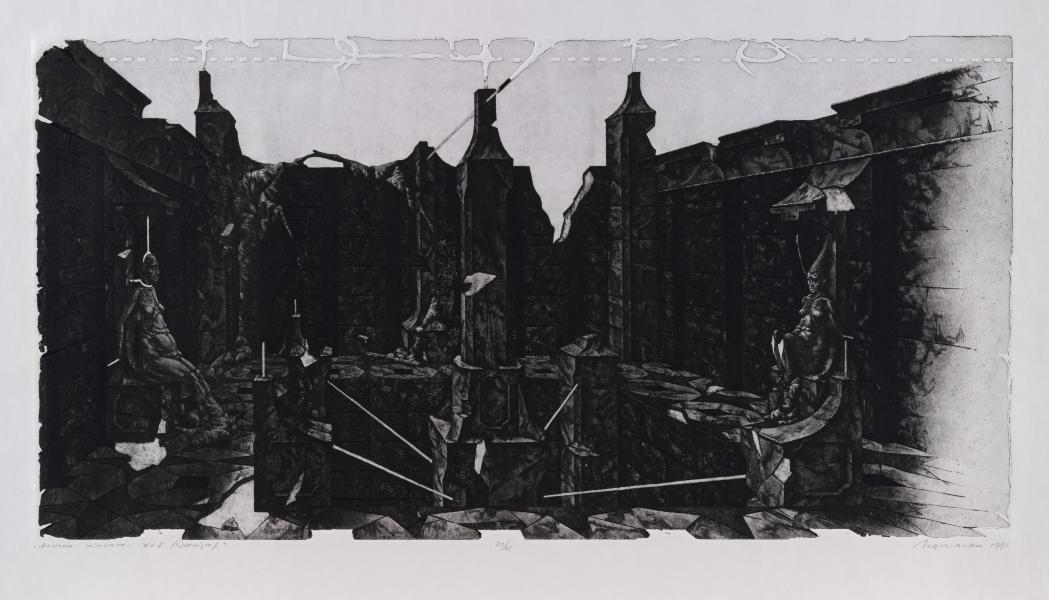
A monochrome black and white print (25.1 х 48.2 cm) with embossing on the upper edge depicts two naked women sitting opposite each other in an architectural structure. The building has a mosaic floor and is surrounded by three stone walls. The left and right walls have stone consoles at the top, forming a cornice. In the corners of the adjoining walls are tall rectangular columns with pyramidal tops. In the centre of the courtyard is a recess on the floor with a three-tiered pillar in the centre, two pillars in the two corners of the recess, and two cube-shaped objects in the foreground. All the elements are stone and carved. The walls of the courtyard have a grey and white background. The women depicted are seated on cube-shaped thrones on opposite walls. At the top of each throne, there are stone consoles. The woman on the right is depicted either with a conical cap on her head or with such a hairstyle. Her legs are closed together, bent at the knees and raised to the level of her navel. The head of the woman on the left is attached to the upper console of the throne by a white vertical horn. In place of the lower legs and feet, there is an amorphous mass, like the woman on the right.
"Igor Podolchak is a young Ukranian artist who has come into maturity as most of the political emblems of Soviet communism have been dismantled. To 'western' eyes adjusting in the light of Glasnost these grimly comic tableaux of Podolchak's appear to be macabre residues of an unconscious history. The artist recovers these repressed memories in a pictorial language that combines Surrealist effrontery with a neo-Gothic repertoire of demons, fools and hellish tormentors. In what could be private and dark corners of – equally – some torture chamber in a remote castle, some diabolical clinic operated by a vivisector, or some maniacally disciplinarian school room, these creatures perform obscure but intensely cruel rituals upon each other and upon themselves.
They are inextricably bound to a fantastic machinery that could be derived from Dr Frankenstein's laboratory, the Marquis de Sade's chateau or Franz Kafka's penal colony. Their limbs and organs fall away to reveal grotesquely implausible prosthetic devices that accentuate their mutilations. Their flesh is torn away in strips like bondage straps, or it drips off them, coagulates like glue on the walls and floors, or is petrified as stone or as an abominable excretion.
Alluding to the monstrosities of Hieronymus Bosch, Otto Dix, Max Ernst and Salvador Dali, Podolchak invokes a violently sensual and perverse force of metamorphosis. A kind of hysteria grips the imagery in this sarcastic fantasy: an ambiguous condition since it requires both intensity and also distraction. Because of this ambiguity we might confuse hysteria with ecstasy: psychoanalysts suggest that where hysteria is an illness, ecstasy is considered a state of grace. For an artist sensitive to this underlying similarity, hysteria can be regarded as the obscene side of ecstasy. These creatures are obscene not only because they strain or lurch comically and horrifically in spastic poses; in the perpetual torment of their inescapable hermetic society, they also cripple our own sense of moral distinction and judgement – conflating the worlds of the living and the dead, victim and master, the saved and the damned.
Their flesh convulses in the rigid grip of desire locked onto repression: whose erotic machines (manufactured from mysterious quasi-religious and political signs) weigh down, enclose, constrain, contort the lust of their supplicants.
In their Gothic guise these sorts of grotesqueries represented human depravities given their apocalyptic form, that is to say their true form behind appearance, the revelation of otherwise hidden human sin as it will appear on the Judgement Day. Are Podolchak's visions in this fantastic space of repression likewise apocalyptic, though perhaps signalling a political dread of Orwellian nightmares becoming ecstatic?" (Edward Colless, "Essay". To the exhibition catalogue "Igor Podolchak. Ukrainian Printmaker", 1991).
https://eprints.utas.edu.au/18624/1/Igor_Podolchak_Ukrainian_printmaker_1991.pdf
"Igor Podolchak is a young Ukranian artist who has come into maturity as most of the political emblems of Soviet communism have been dismantled. To 'western' eyes adjusting in the light of Glasnost these grimly comic tableaux of Podolchak's appear to be macabre residues of an unconscious history. The artist recovers these repressed memories in a pictorial language that combines Surrealist effrontery with a neo-Gothic repertoire of demons, fools and hellish tormentors. In what could be private and dark corners of – equally – some torture chamber in a remote castle, some diabolical clinic operated by a vivisector, or some maniacally disciplinarian school room, these creatures perform obscure but intensely cruel rituals upon each other and upon themselves.
They are inextricably bound to a fantastic machinery that could be derived from Dr Frankenstein's laboratory, the Marquis de Sade's chateau or Franz Kafka's penal colony. Their limbs and organs fall away to reveal grotesquely implausible prosthetic devices that accentuate their mutilations. Their flesh is torn away in strips like bondage straps, or it drips off them, coagulates like glue on the walls and floors, or is petrified as stone or as an abominable excretion.
Alluding to the monstrosities of Hieronymus Bosch, Otto Dix, Max Ernst and Salvador Dali, Podolchak invokes a violently sensual and perverse force of metamorphosis. A kind of hysteria grips the imagery in this sarcastic fantasy: an ambiguous condition since it requires both intensity and also distraction. Because of this ambiguity we might confuse hysteria with ecstasy: psychoanalysts suggest that where hysteria is an illness, ecstasy is considered a state of grace. For an artist sensitive to this underlying similarity, hysteria can be regarded as the obscene side of ecstasy. These creatures are obscene not only because they strain or lurch comically and horrifically in spastic poses; in the perpetual torment of their inescapable hermetic society, they also cripple our own sense of moral distinction and judgement – conflating the worlds of the living and the dead, victim and master, the saved and the damned.
Their flesh convulses in the rigid grip of desire locked onto repression: whose erotic machines (manufactured from mysterious quasi-religious and political signs) weigh down, enclose, constrain, contort the lust of their supplicants.
In their Gothic guise these sorts of grotesqueries represented human depravities given their apocalyptic form, that is to say their true form behind appearance, the revelation of otherwise hidden human sin as it will appear on the Judgement Day. Are Podolchak's visions in this fantastic space of repression likewise apocalyptic, though perhaps signalling a political dread of Orwellian nightmares becoming ecstatic?" (Edward Colless, "Essay". To the exhibition catalogue "Igor Podolchak. Ukrainian Printmaker", 1991).
https://eprints.utas.edu.au/18624/1/Igor_Podolchak_Ukrainian_printmaker_1991.pdf
Inscriptions
Below the print is a pencil inscription: "'Magic Room 7x7 /Priapism /' 20/61 Podolchak 1991".
Legal regulation
Borys Voznytskyi Lviv National Art Gallery