Self-Portrait
Arnold Sharhorodskyi


Basic information
- ID
- Ф.Шар.Арх.ЛКГ-17
- Author
- Arnold Sharhorodskyi
- Name
- Self-Portrait
- Date of creation
- 1965
- Country
- the USSR
- Culture
- Art of the Soviet period
- Technique
- mixed technique
- Material
- canvas oil
- Dimensions (height x width, cm)
- 69.5 x 59.5
Additionally
- Type
- painting
- Genre
- portraiture
- Plot
- Self-portrait
- Provenance
- Handed over to the museum from Arnold Sharhorodskyi
Information about author
Object description
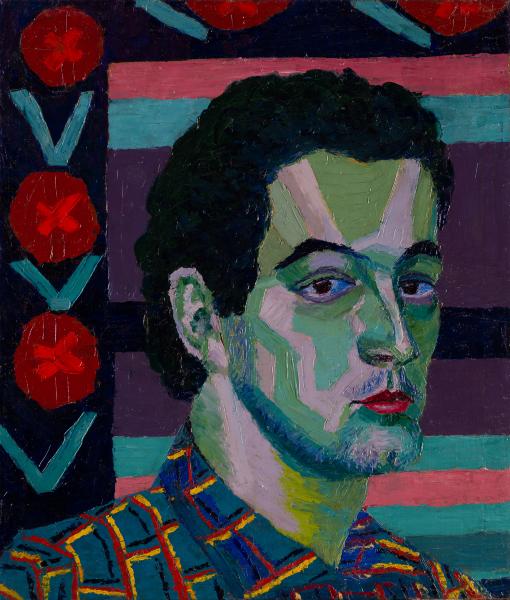
The canvas depicts a full-length self-portrait of a young man facing the viewer at three-quarters length. The sitter and the background are rendered contrasting and decorative while respecting the plastic anatomy and preserving the portraiture's features. It is worth noting that even the sitter's light-coloured Western shirt is recognisable and characteristic of the 1960s, probably made in the USA and probably purchased from one of the local black market profiteers. The author's approach to stylisation is in line with the practice of Ernst Ludwig Kirchner, especially his self-portraits of 1925–1935, with the use of decorative fabric with large motifs for the background in the left part (in this work by Arnold Sharhorodskyi, these are rich geometric flowers with shoots). It should be noted that the artist's use of colour contributes to the disclosure of the sitter's psycho-emotional state and, above all, to the self-conception of his personality with its expressive dramatic and existential aspects. The decorative approach using tonal and colour contrasts and the introduction of saturated tones, both warm (red and yellow) and cold (green and blue), do not give the impression of excessive colourfulness, and the geometric motifs emphasise the individual features of the man's face.
Portrayed person
- The name of the person portrayed
- Arnold Sharhorodskyi
- Lifetime of the person portrayed
- 1946–2015
Legal regulation
Borys Voznytskyi Lviv National Art Gallery