Saint
unknown (Italian School)



Basic information
- ID
- Ж-1493
- Author
- unknown (Italian School)
- Name
- Saint
- Date of creation
- 18th c.
- Country
- Italy
- Technique
- oil painting
- Material
- canvas oil
- Dimensions (height x width, cm)
- 74.5 x 51.5
Additionally
- Type
- painting icon
- Genre
- religious
- Plot
- Saint
- Provenance
- Collection of Leon Pininski
- Exposition
- Potocki Palace
Information about author
Object description
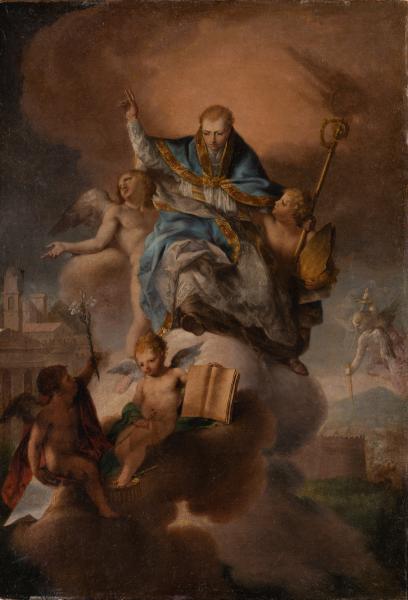
The canvas depicts a young man in blue episcopal robes adorned with gold trim. He is seated on a cloud, supported by angels; one holds the bishop's mitre, gazing down at the earth from which he is being taken to heaven. The man blesses the city below him with his right hand while he holds the bishop's staff in his left hand. The angel sitting directly below the saint holds an open Gospel, while the angel on the left extends a white lily to the saint. Somewhat behind the main group of figures, an angel flutters, sheathing a sword. The painting likely depicts Saint Januarius (275–305), a martyr and bishop revered by both the Catholic and Orthodox Churches, who is the patron saint of Naples and is known for having protected the city from the plague and the eruption of Mount Vesuvius. His attributes include the sword with which he was executed, the Gospel, and the lily – a symbol of purity and holiness. During the reign of Emperor Diocletian, Januarius was arrested for conducting a Christian liturgy. Along with deacons and believers, he was thrown into a furnace but did not burn, cast to wild beasts in the arena but remained unharmed, and ultimately was beheaded by the sword at the age of 30. The iconography of the saint is quite rich. He was depicted by renowned masters such as Luca Giordano and Jose de Ribera.
Legal regulation
Borys Voznytskyi Lviv National Art Gallery