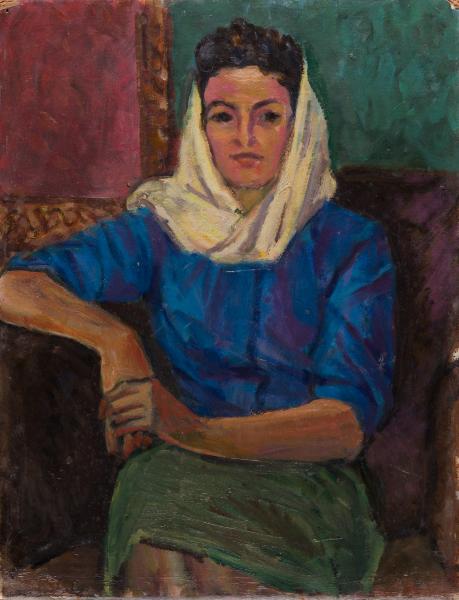
Portrait of Zh. Maksymovych
Roman Turyn


Basic information
- ID
- Ж-5707
- Author
- Roman Turyn
- Name
- Portrait of Zh. Maksymovych
- Date of creation
- 1964
- Country
- the Ukrainian SSR
- Culture
- Contemporary times
- Technique
- oil painting
- Material
- cardboard oil
- Dimensions (height x width, cm)
- 63 x 48.5
Additionally
- Type
- painting
- Genre
- portraiture
- Plot
- Portrait
- Provenance
- Gifted by a private individual
Information about author
Object description
The decorative, figurative and colourful "Portrait of Zh. Maksymovych" was painted in 1964, when R. Turyn was developing his artistic style based on modernist inspirations. Thus, the painting is related to the experience of Post-Impressionism through "the realisation of not an impression, but a stable visual perception", the self-sufficiency and autonomy of the painting surface, and the combination of structure and intense drama of colours. At the same time, the work resembles Fauvism in the characterisation of the sitter, especially in terms of colour, with the juxtaposition of deep purple, carmine, blue, green, peach, and gold tones. The white headscarf, the lightest tonal accent in the painting, adds to the expressiveness of the face. The peculiarity of the picture lies in the contrast between the almost fresco-like monumentality, the strength and tenderness reflected in the flowing line of the hands, the soft contours and the charm of the features. The portrait's ethno-cultural inspiration is evidenced by the similarity of the headscarf to an ancient Ruthenian woman's headdress and the surface of the canvas to the colourful variety of folk carpets.
Legal regulation
Borys Voznytskyi Lviv National Art Gallery