Back

Autumn

Karlo Zvirynskyi

  • Autumn 2
  • Autumn 3
Basic information
ID
Ж-5723
Author
Karlo Zvirynskyi
Name
Autumn
Date of creation
1965
Country
the Ukrainian SSR
Culture
Contemporary times
Technique
oil painting
Material
canvas oil
Dimensions (height x width, cm)
118.5 x 99.8
Information about author
Author
Karlo Zvirynskyi
Artist's lifetime
1923–1997
Country
Poland, the Ukrainian SSR
Biography
Karlo Zvirynskyi was born on 14 August 1923 in the village of Lavriv in the Lviv region. In 1942–1943, he studied at the Lviv State Art and Industrial School at the Department of Graphic Arts under Mykola Butovych and Volodymyr Balyas. From September 1943, he continued his studies at the Department of Painting (in the studio of Mykhailo Kozyk) in the newly created art educational institution "Higher Fine Arts Studios" (Hoheren Kunstmalerfachstudien). In September 1945, he entered the fifth year of the Department of Painting at the Lviv School of Applied Arts (now the Ivan Trush Lviv State College of Decorative and Applied Arts), where he studied under Roman Selskyi. In 1947–1953, he continued his studies under R. Selskyi at the Lviv Institute of Applied and Decorative Arts (now the Lviv National Academy of Arts), Department of Monumental Painting (with a one-year break in 1949–1950, when he was expelled for "bourgeois nationalism and the spread of formalist tendencies in art"). It was under the influence of his teacher that K. Zvirynskyi became interested in the experience of Cubism, Abstractionism, Dadaism, Fauvism, and Surrealism, based on which he later formed his distinctive painting style. In 1953–1959, K. Zvirynskyi taught painting and composition at the Ivan Trush Lviv State College of Decorative and Applied Arts. In 1959–1982, he continued his teaching activity at the Lviv State Institute of Applied and Decorative Arts. In 1982, for refusing to cooperate with the Committee for State Security (KGB/KDB), he was not allowed to run for re-election to his position. In 1990, he resumed his teaching career as a professor of the Department of Monumental Painting at the Lviv Academy of Arts. In the 1950s–1980s, in K. Zvirynskyi's apartment, there was an "underground" art school for creative youth, the purpose of which, in addition to artistic studies, was to study world and Ukrainian culture and form national consciousness. Informal professional communication contributed to the creative formation of several well-known Lviv artists: A. Bokotei, I. Marchuk, O. Minko, P. Markovych, R. Petruk, B. Soika, and Z. Flinta. This prompted K. Zvirynskyi to be recognised as the "father of the modern Lviv school of painting" (Y. Boiko). The influence of Post-Impressionism marks Zvirynskyi's early works. In the early 1950s, the artist began experimenting with the "pure shape" and persistently sought purely formal, colouristic and compositional solutions to creative tasks. Since 1957, he used paper, wood, tin, fabric, ropes, and plaster to create relief compositions. He created exquisitely restrained gradations of black, grey and ochre colours. The peculiarity of the artist's works of the late 1950s is visual and musical synesthesia and understanding of visible forms as representations of transcendental spiritual reality, the will of the Creator. In 1960, a new stage began in K. Zvirynskyi's work, marked by the transition to "textureless" painting and combinations of black, white, red, green, and ochre colours, full of mystical sounds. At the same time, K. Zvirynskyi's art gradually developed a new figurative and plastic concept – "abstract surrealism". In the conditional irrational space of the canvases, the artist placed various abstract forms, fantasy objects, and signs, which, like living beings, created a mysterious world involved in the Absolute and the will of the Creator. In the works of the last decade, K. Zvirynskyi returned to a more active colour scheme and actualised and creatively rethought the concepts of his early works. The master's oeuvre includes sacred artistic works based on the traditions of ancient Ukrainian iconography in combination with high colouristic culture and plastic sense.
Object description
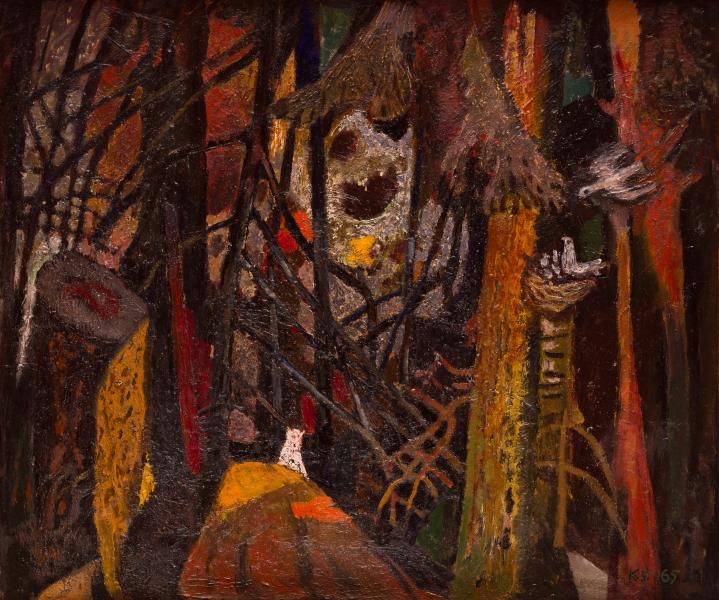
The peculiarity of K. Zvirynskyi's work is comprehending the material world as full of divine energies, a reflection of the Creator's will. The artist's creative credo is reflected in the lines of the apocryphal Gospel, reproduced in a manuscript kept in the studio during Zvirynskyi's lifetime: "I will split a log and see You, I will lift a stone and find You there." In the painting "Autumn" (1965), the expression of the artist's pantheistic beliefs about the unity of God and the world, the soul and the world, the soul and God was served by Post-Impressionist shape formation based on the reduction of the visible to the present in the collocation of colour planes. An aspect of the artistic image is the actualisation of folklore ideas about the forest as a remote, uncultivated space, opposite to the home in the archaic opposition "someone else's – one's own". The tension of the landscape is created by the idea of the forest as a dangerous liminal (transitional) locus associated with obstacles, their overcoming, search, and path. The image of an abandoned white dog on a hill among the mighty tree trunks is perceived as the embodiment of absolute existential loneliness. The contrasts of light and dark, warm and cold, ghostly lighting and the moon against the ominous sky background add to the drama of the image. At the same time, the work raises the problem of alienation from the environment, which probably has a social connotation. In the work, it is visualised by the strangeness of a domestic animal to the centuries-old thickets that are home to the birds depicted on the right. The Post-Impressionist "markers" of the work are the levelling of three-dimensionality, dense colour, and the assertion of the intrinsic value of the picture plane.
Inscriptions
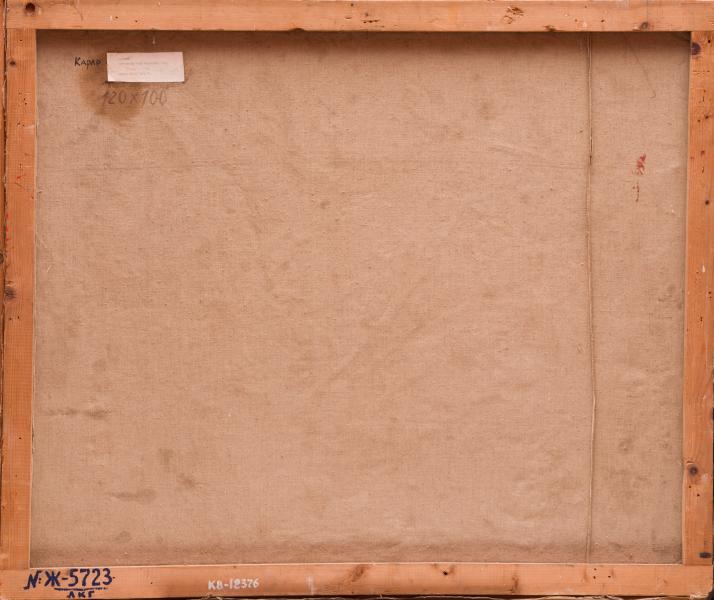
On the back in the upper right corner is an inscription: "KAP-10".
Legal regulation
Borys Voznytskyi Lviv National Art Gallery