Back

Still Life with Cellophane

Zenovii Flinta

  • Still Life with Cellophane 2
  • Still Life with Cellophane 3
Basic information
ID
Ж-6648
Author
Zenovii Flinta
Name
Still Life with Cellophane
Date of creation
1983
Country
the Ukrainian SSR
Culture
Contemporary times
Technique
oil painting
Material
fibreboard oil
Dimensions (height x width, cm)
73 x 60.5
Additionally
Type
painting
Genre
still life
Information about author
Author
Zenovii Flinta
Artist's lifetime
1935–1988
Country
Poland, the Ukrainian SSR
Biography
Zenovii Flinta (1 September 1935, Toky village – 2 April 1988, Lviv) was a Ukrainian ceramicist, painter, and graphic artist. Member of the Ukrainian Union of Artists, Honoured Artist of the UkrSSR. He was born in the village of Toky, Ternopil region. After graduating from a seven-year school, he entered the Ivan Trush Lviv School of Applied Arts, Department of Decorative Painting. He graduated in 1959. In 1959–1963, he studied at the Lviv State Institute of Applied and Decorative Arts, Department of Art Ceramics. From 1963, he taught at the painting department of the Ivan Trush Lviv School of Applied Arts. From 1965 to 1975, he worked as a teacher of ceramics at the Lviv State Institute of Applied and Decorative Arts. In 1967, he interned at the Gdansk Academy of Fine Arts, and in 1968, at the Warsaw, Krakow and Wroclaw Academies of Fine Arts. From 1970, he worked at the Lviv Ceramics and Sculpture Factory. In 1971, he headed the decorative and applied arts section of the Lviv branch of the Ukrainian Academy of Arts. Since 1960, he has participated in Republican exhibitions and, since 1968, in all Union exhibitions. He participated in the International Biennial of Ceramics in Faenza (Italy, 1973) and Vallauris (France, 1974). In 1982–1983, there was a successful group exhibition of Zenovii Flinta, Oleh Minko, and Liubomyr Medvid in Lviv, Kyiv, and Vilnius. In 1985, a solo exhibition of Z. Flinta's works was held in Lviv, including paintings, graphics, and ceramics. Conceptually and plastically, many of Z. Flinta's paintings are inspired by the works of P. Cézanne, P. Picasso, G. Braque, O. Archipenko, F. Léger, H. Matisse, and the Ukrainian avant-garde of the 1910s and 1930s. The movement of the sixties, Roman Selskyi and Karlo Zvirynskyi, had a significant influence on his creative search. Many of Z. Flinta's paintings are characterised by allegorism and the revelation of deep philosophical meanings through visible objects, forms, and colour combinations. In painting, the artist preferred pastels and tempera. In ceramics, he concentrated on the technique of painting to achieve pictorial and graphic effects. The artist's early works are characterised by the use of ornamental motifs from the folk art of the Carpathians. The colour palette is based on a combination of brown, green, and ochre with the addition of black and white.
Object description
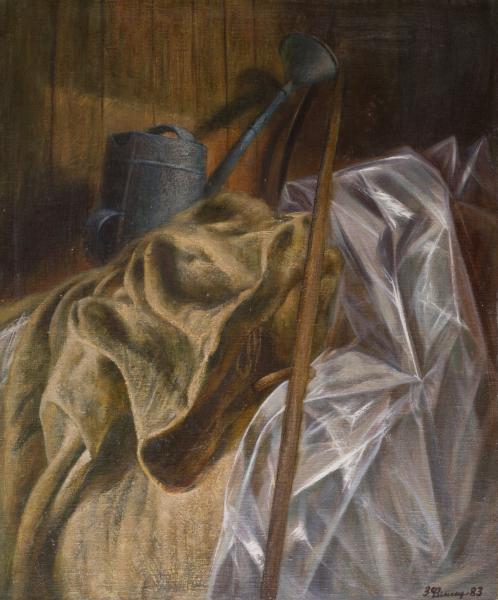
An essential component of Z. Flinta's creative work is still lifes, where the world of things is transformed into symbols and allegories – expressions of the meanings of life. Thus, in "Still Life with Cellophane", the master reflects the opposition of man-made and natural, modern industrial civilisation and everyday life of the Ukrainian village through the medium of everyday objects. Thus, the folk life is marked by a watering can, a row of clothes, and a natural wooden wall background. The sign of the artificial, synthetic, "unnatural" is transparent cellophane. The semantic opposition is reproduced in colour, contrasting warm brown-ochre and cold white-silver-grey tones. Formative experiments are an important aspect of the work, and they are visible in the Cubist destruction of draperies into many geometric planes. The perception of a still life as a field of formal Cubist experiments can be found in other works of the artist ("Drapery", 1974; "Oilcloth", 1983).
Legal regulation
Borys Voznytskyi Lviv National Art Gallery