Back

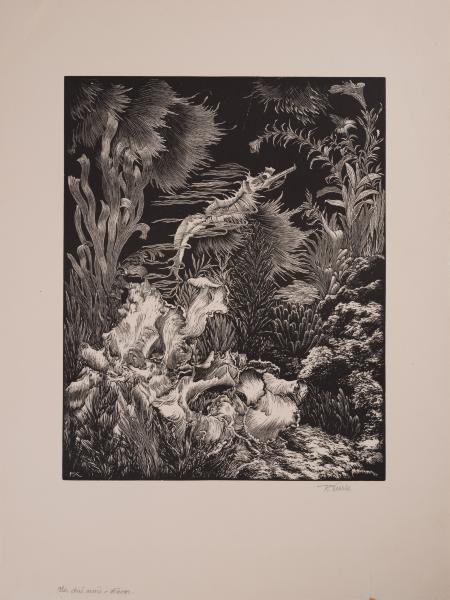
At the Bottom of the Sea

Frantisek Kobliha

  • At the Bottom of the Sea 2
  • At the Bottom of the Sea 3
Basic information
ID
Г-IV-2102
Author
Frantisek Kobliha
Name
At the Bottom of the Sea
Date of creation
1925
Country
Czech Republic
Technique
woodcut
Material
paper
Dimensions (height x width, cm)
29.9 x 24
Additionally
Information about author
Author
Frantisek Kobliha
Artist's lifetime
1877–1962
Country
Czech Republic
Biography
Frantisek Kobliha (1877–1962) was a Czech graphic artist and art critic. In 1910–1912, he headed the SURSUM group, whose members were engaged in artistic, spiritual, and occult practices. The members of the group were considered the second generation of Symbolists. Frantisek Kobliha was also one of the most influential artists and art critics of the Czech publication "Moderni Revue". Kobliha was educated in Prague at the Umprum School of Applied Arts (1896–1899) and then at the Academy of Arts, where he studied painting under Frantisek Zenisek, a representative of the academic painting style. In his creative work, Kobliha abandoned colour for black-and-white tonal variations. He worked in the techniques of lithography, drypoint, and wood engraving. In addition, he worked as a book illustrator. During the 1920s, the artist published works by such authors as Julius Zeyer (1841–1901), Jiří Karasek (1871–1951), Jan Opolsky (1875–1942), Rudolf Medek (1890–1940), and others. Kobliha also worked on bibliographical editions of literary works published by Kamilla Neumannova (1874–1957), often using floral motifs and the story's central figure as a frontal painting. The artist's oeuvre is characterised by an atmosphere of introspection and the creation of imaginary compositions, although his creative heritage also includes realistic landscapes from Czech villages. The main series of works by Frantisek Kobliha: "Simple Motifs" (1908), "Tristan" (1909–1910), a series of landscapes of Prague (1914), a series of lithographs "Fantasies of Moonlight Nights" (1944–1946), etc.
Object description
The work shows a seafloor landscape. Various seaweeds are depicted on the bottom of the sea. On the lower left are broad, lobed leaves, while to the right are clusters of stick-like marine plants, behind which is a large accumulation of stone boulders. In the upper part, against a black background, a fantastical fish (possibly a seahorse) with many thin, wavy fins swims upward to the right. To the left of it is a bush of wavy leaves, and in the right corner, the leaves resemble sedge and horsetail. Broad leaves are swaying in the water at the top, on the left and right. The depiction of an underwater fantastical world was popular in the Art Nouveau and Secession movements.
Inscriptions
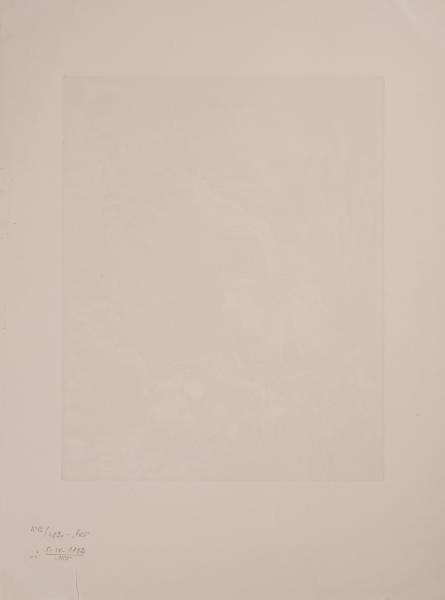
In the lower left corner, there is the artist's signature: "F. K.". On the right side below the engraving: "F. Kobliha". On the left edge of the sheet, there is an inscription in Czech: "Na dnē moře – drevor".
Legal regulation
Borys Voznytskyi Lviv National Art Gallery