Parable of the Talents
unknown


Basic information
- ID
- Ж-1625
- Author
- unknown
- Name
- Parable of the Talents
- Date of creation
- 2d half of the 17th c.
- Country
- Holland
- Technique
- oil painting
- Material
- wood oil
- Dimensions (height x width, cm)
- 61 x 84
Additionally
- Type
- painting
- Provenance
- Collection of Lviv City Gallery
- Exposition
- Potocki Palace
Information about author
Object description
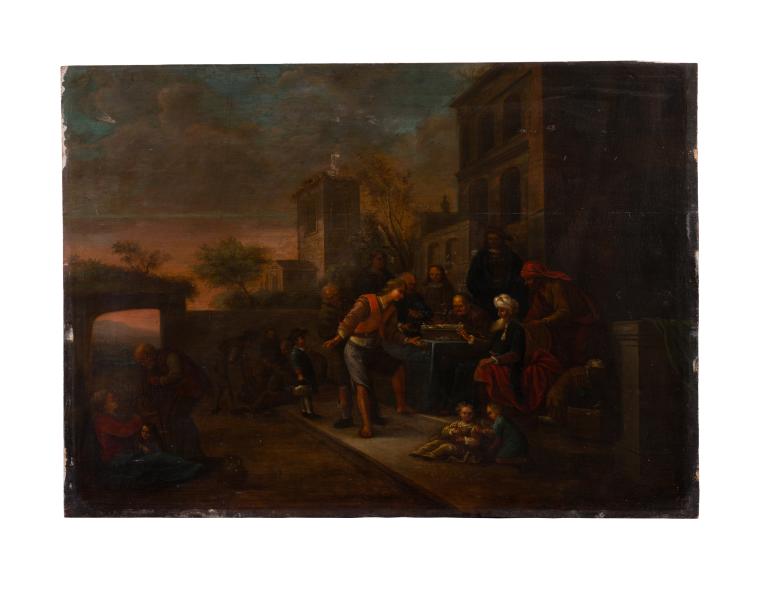
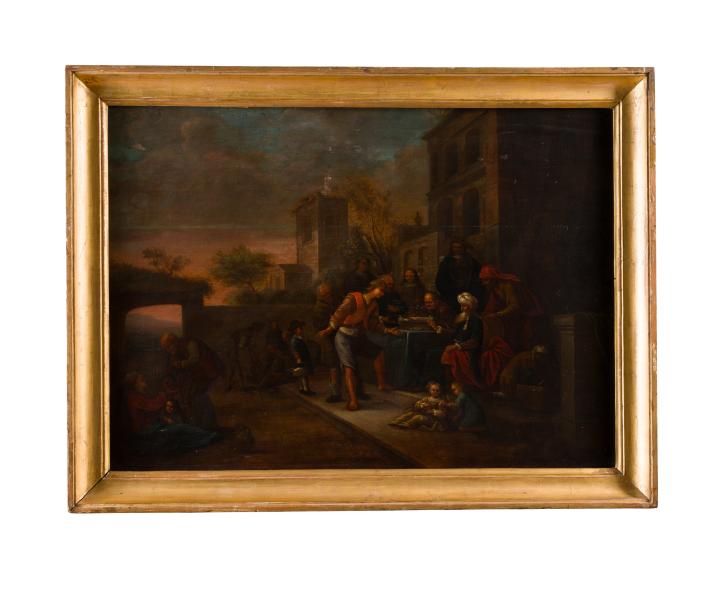
In the painting, against a backdrop of houses and trees, a scene is depicted with several figures. On the left in the foreground, a man leans on a stick as he speaks to a woman sitting on the ground with a child. In the background, under a wall, there is another group of people. Their figures are unclear as if fading into the shadows of the sunset. In the right corner of the artwork, another group of men gathered around a table covered with a blue cloth. The main action takes place there. In front of the table, a man leans forward. He is wearing grey trousers, a white shirt, and an ochre-red vest over it. With his left hand, he extends coins to a grey-bearded man in a white turban. Behind the host is a man in a red kufi. Six men are watching the process, their gazes fixed on the coins. On the stairs, despite the adults' troubles, children are playing carefreely. In the work of an unknown Dutch artist, a moment from the "Parable of the Talents" is depicted: "Master, he said, you entrusted me with five bags of gold. See, I have gained five more" (Matthew 25:20). "For whoever has will be given more, and they will have an abundance. Whoever does not have, even what they have will be taken from them" (Matthew 25:29). The "Parable of the Talents" is a continuation of the previous "Parable of the Ten Virgins", emphasising the importance of sacrificial love for one's neighbours: "...whatever you did for one of the least of these brothers and sisters of mine, you did for me" (Matthew 25:40). This theme has been used by many artists throughout various historical periods.
Legal regulation
Borys Voznytskyi Lviv National Art Gallery