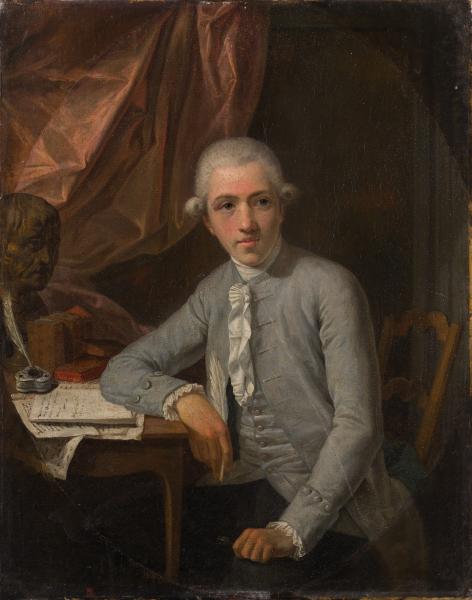
Portrait of Joachim Winckelmann
Johann Georg Wille


Basic information
- ID
- Ж-431
- Author
- Johann Georg Wille
- Name
- Portrait of Joachim Winckelmann
- Technique
- oil painting
- Material
- canvas oil
- Dimensions (height x width, cm)
- 33.6 x 28.5
Additionally
- Type
- painting
- Genre
- portraiture
- Plot
- Portrait
- Exposition
- Potocki Palace
Information about author
Object description
The painting depicts a young man seated at a table, turned toward the viewer. Before us is a young art scholar, theorist of Classicism, and historian, Joachim Winckelmann. He was a German art historian and antiquarian, the founder of modern concepts of ancient art and archaeology. Born into a poor family, he was nevertheless allowed to attend a gymnasium in Berlin, from which he graduated in 1736. Two years later, he was awarded a scholarship to study theology at the University of Halle, where he primarily focused on ancient literature. After graduating from the university in 1740, he worked as a private tutor for quite some time. From 1741, he studied medicine, and between 1743 and 1748, he worked at a school near Berlin, where he taught Hebrew and Greek, as well as geometry, logic, and Latin. Later, he worked as a librarian near Dresden, allowing him to view and study the artistic treasures collected there. After visiting Naples, Herculaneum and Pompeii in 1758, Joachim published his major work, "The History of the Art of Antiquity". From 1763, he served as the chief antiquarian and "President of Antiquities" at the Vatican. The artist depicted him as a young scholar, surrounded by the attributes of learning – notes and an inkwell.
Portrayed person
- The name of the person portrayed
- Joachim Winckelmann
- Lifetime of the person portrayed
- 1717–1768
Legal regulation
Borys Voznytskyi Lviv National Art Gallery