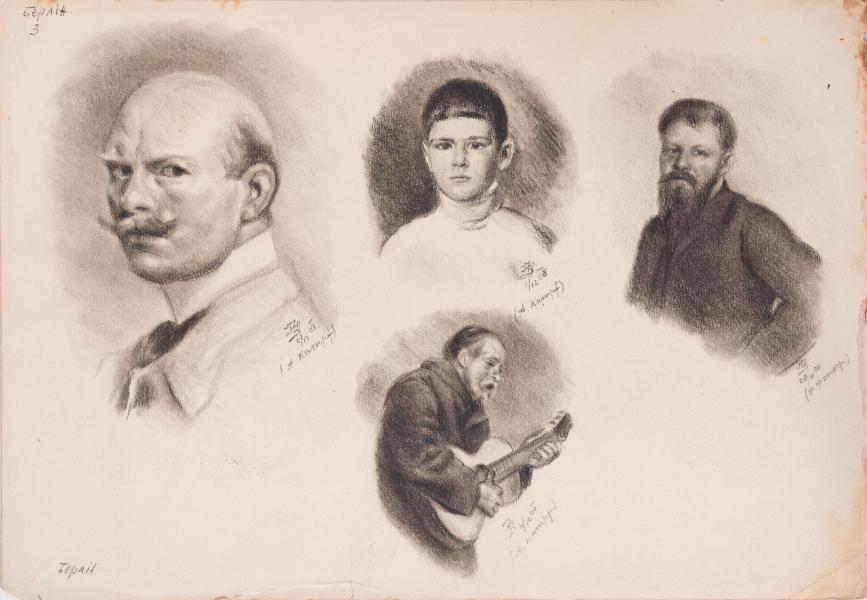
Drawing of Four Male Busts
Yulian Zaiats


Basic information
- ID
- Ф-З-Арх-ЛГМ-5/3
- Author
- Yulian Zaiats
- Name
- Drawing of Four Male Busts
- Country
- German Empire
- Technique
- drawing
- Material
- paper charcoal ink
- Dimensions (height x width, cm)
- 20.3 x 29.2
Additionally
- Type
- graphic art
- Genre
- portraiture
- Plot
- Portrait
- Provenance
- Received from Nina Zaiats
Information about author
Object description
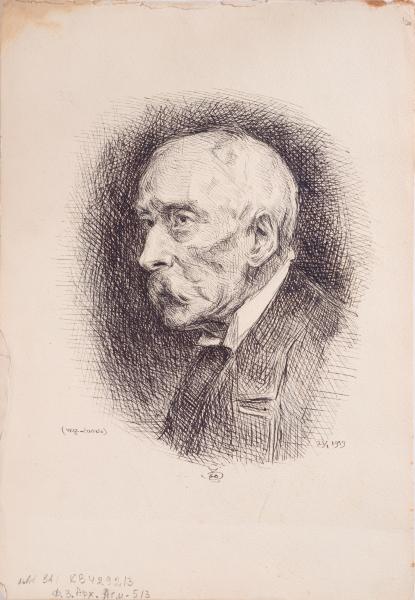
The front of the sheet features the author's variations on graphic works by German artist Arthur von Kampf, including a variation on one of his self-portraits, as well as types of characters commonly found in this artist's work. It should be noted that during the period when Yulian Zaiats was in Berlin, Arthur von Kampf's works were devoted to both social portraits and the recording of images of his contemporaries. Later, after Adolf Hitler came to power, Arthur von Kampf (the "von" in his surname appeared in 1921) joined the NSDAP (National Socialist German Workers' Party) and was personally included by A. Hitler on the Gottbegnadeten-Liste as one of the most outstanding artists of the Third Reich. It should be noted that from that time on, Arthur von Kampf's works were mostly devoted to promoting Nazi values and aesthetics, in particular the cultivation of images associated with racial purity (the so-called idea of Blut und Boden). However, at the time when Yulian Zaiats turned to studying the painting and graphic art of Arthur Kampf, the latter was an example of realistic research and development of psychological portraits of representatives of various social classes. Among Arthur von Kampf's works, as in the case of Yulian Zaiats, we find copies and replicas of outstanding artists of the past, in particular Anthony van Dyck (as in the work with inventory number Ф-З-Арх-ЛГМ-5/2). The first full-length portrait on a graphic sheet is a copy of Arthur von Kampf's self-portrait, which shows a middle-aged man with pronounced hair loss, a moustache characteristic of the fashion of the time (similar, for example, to the image of Paul von Hindenburg (1837–1934) and a sharp, focused gaze. Part of the upper clothing is stylised, but a characteristic stand-up collar is visible. Next to this portrait, in the centre of the sheet, we see a shoulder-length image of a boy with short dark hair, soft facial features, and in adolescent clothing typical of the time. Below the image of the boy is a portrait of the torso of an elderly man with a beard and moustache, probably a Jewish man (he is wearing a kippah), who is playing the guitar and, judging by his facial expression, singing. To the right of the central image of the boy is an image of part of the torso of a bearded man in city clothes. On the reverse side of the graphic sheet is a full-length figure of an elderly man with a moustache in urban attire of the time, shown almost in profile. It is worth noting here how carefully the artist strives to reproduce the portrait features of the man and emphasise his affinity with the aesthetics of European Baroque art. It should be noted that both this image and the image on the front of the sheet are presented as a medallion, where part of the background is marked with conventional hatching.
Inscriptions
In the lower left corner, there is an inscription in Cyrillic: "Berlin". Under each of the four images is Yulian Zaiats' monogram and an inscription in German in parentheses: "(A. Kampf)", as well as dates (from left to right): "5/12 08"; "1/12 08"; "6/ 12 08"; "29/ 12(?) 08". Reverse: "изъ" [illegible]; "21/1 1919".
Portrayed person
- The name of the person portrayed
- Arthur von Kampf
- Lifetime of the person portrayed
- 1864–1950
Legal regulation
Borys Voznytskyi Lviv National Art Gallery