Drawing of a Woman's Head
Yulian Zaiats


Basic information
- ID
- Ф-З-Арх-ЛГМ-5/18
- Author
- Yulian Zaiats
- Name
- Drawing of a Woman's Head
- Date of creation
- 21.02.1919
- Country
- the Second Polish Republic
- Technique
- drawing
- Material
- paper Indian ink
- Dimensions (height x width, cm)
- 20.7 x 15.2
Additionally
- Type
- graphic art
- Genre
- portraiture
- Plot
- Portrait
- Provenance
- Received from Nina Zaiats
Information about author
Object description
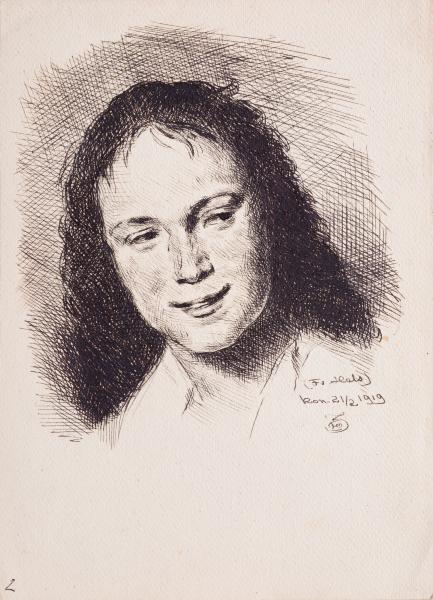
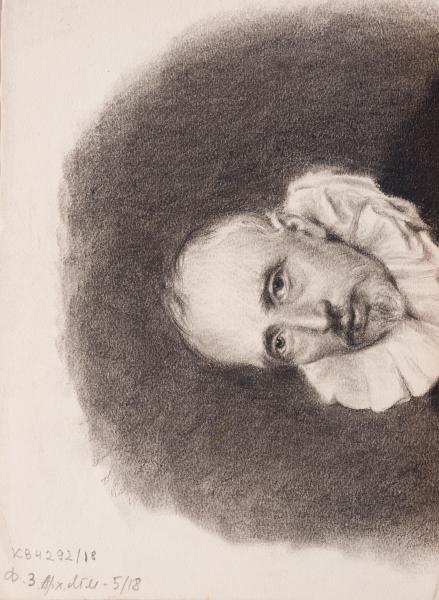
On the obverse side is a drawing interpretation of the image of The Gypsy Woman by Frans Hals (1628), executed in ink with a pen. The artist focused not on the development of the texture of the clothes or the background, but on conveying the gesture, gaze, and general movement of the figure. Only a bust image of a woman in a three-quarter turn, with a characteristic smile and a flirtatious pose, is depicted. Particular attention is paid to the contrasting modelling of the shapes: a subtle, dynamic stroke that plastically outlines the lines of the shoulders, neck, arms, and face, accurately reproducing the lively energy of the original work. The relaxed expression, smile, and slightly tilted head convey the model's spontaneity and character, which was probably the author's goal in studying the ability of the line to convey psychological expression. Beyond the standard academic canon, the image of the Gypsy Woman in this interpretation retains openness, vitality, and even a challenge to the viewer, features inherent in the pictorial language of Frans Hals. On the reverse side of the sheet is a drawing copy of a portrait of the collector Cornelis van der Geest (ca. 1620), based on a painting by Antonis van Dyck. The image was drawn in pencil with special attention to the psychological expressiveness of the model, and is sustained in the aesthetics of restrained aristocracy inherent in the portraits of the Flemish school of the first half of the seventeenth century. The bust image of the man is presented in a three-quarter turn, with a deep, but not direct gaze. The composition balances between the plasticity of modelling and graphic restraint: the light face and dark clothes add depth to the image and emphasise the features. The forehead, nose, cheeks, and chin are emphasised by a soft shadow, which clearly shows age-related signs: wrinkles, slight fatigue around the eyes, and changes in complexion. The image of Cornelis van der Geest in this graphic version retains its intellectual tension and conveys the image of an art connoisseur; on the contrary, its interpretation focuses on the face, eyes, and slight tilt of the head, which reveal not only status but also a profound personality. This drawing is not only an exercise in the study of Baroque painting, but also a demonstration of the graphic medium's ability to preserve the subtle psychological characteristics of the model inherent in the original.
Inscriptions
"F. Hals"; "21/2 1919"; signature of Yulian Zaiats.
Portrayed person
- The name of the person portrayed
- Cornelis van der Geest (reverse)
- Lifetime of the person portrayed
- 1555–10.03.1638
Legal regulation
Borys Voznytskyi Lviv National Art Gallery