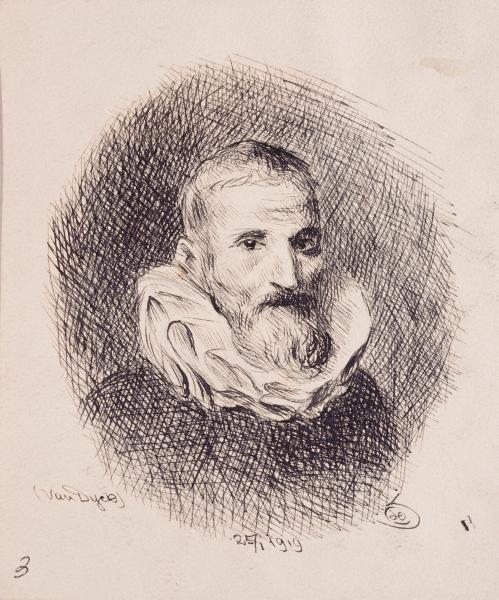
Drawing of an Old Man's Bust
Yulian Zaiats


Basic information
- ID
- Ф-З-Арх-ЛГМ-5/19
- Author
- Yulian Zaiats
- Name
- Drawing of an Old Man's Bust
- Date of creation
- 25.01.1919
- Country
- the Second Polish Republic
- Technique
- drawing
- Material
- paper Indian ink
- Dimensions (height x width, cm)
- 14 x 11.5
Additionally
- Type
- graphic art
- Genre
- portraiture
- Plot
- Portrait
- Provenance
- Received from Nina Zaiats
Information about author
Object description
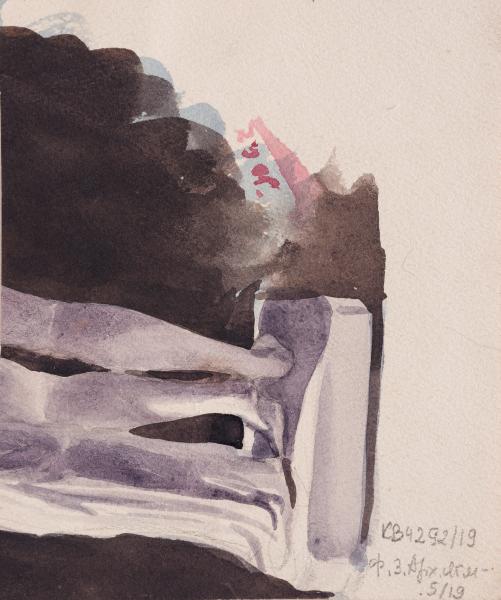
On the front of the sheet is a repetition of a famous painting, namely the portrait of the collector Cornelis van der Geest, created after the original by Anthony van Dyck. This time, the image is created not in pencil but in ink, which lends the portrait greater graphic expressiveness and depth of tone. The main compositional parameters are preserved: a three-quarter turn of the head, the rendering of the face, and the restrained silhouette of the clothes. The model is depicted in a calm pose, with a slight tilt of the head and a focused gaze looking at the viewer. The author of the copy accurately conveys the psychological depth of the image inherent in the Baroque original: dignity, inner peace, concentration – these features are enhanced by the contrast between the light planes of the face and the deep shadows of mascara. The work on the image is especially expressive, showing the desire to convey the age-old truth and intellectual weight of the portrait. Dark clothes and a puffy collar only schematically indicate the volume, without distracting attention from the face, the main emotional centre of the composition. On the reverse side of the sheet is a fragment of a watercolour study based on ancient sculpture. The lower part of a full-length male figure is depicted – only the legs, partially the hips, and the support under the left foot, which refers to famous sculptural examples, such as the Hercules of Farnesia. The watercolour is executed with attention to anatomical accuracy, the transfer of muscle volumes, and the plasticity of the pose. The soft yet controlled application of colour enables us to preserve the sculptural monumentality and, at the same time, convey bodily realism. This fragment continues the studio character of the sheet, indicating the artist's systematic work with examples of the European tradition, where classical antiquity and Flemish portraiture are equivalent sources of learning.
Inscriptions
"Van Dyck"; "25/1 1919"; signature of Yulian Zaiats.
Portrayed person
- The name of the person portrayed
- Cornelis van der Geest (reverse)
- Lifetime of the person portrayed
- 1555–10.03.1638
Legal regulation
Borys Voznytskyi Lviv National Art Gallery