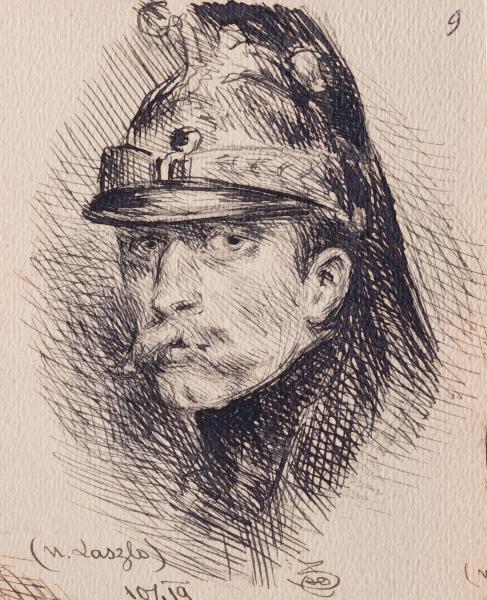
Drawing of a Man's Head
Yulian Zaiats


Basic information
- ID
- Ф-З-Арх-ЛГМ-5/25
- Author
- Yulian Zaiats
- Name
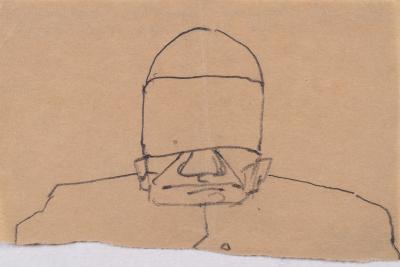
- Drawing of a Man's Head
- Date of creation
- 10.07.1919
- Country
- the Second Polish Republic
- Technique
- drawing
- Material
- paper Indian ink
- Dimensions (height x width, cm)
- 11 x 9
Additionally
- Type
- graphic art
- Genre
- portraiture
- Plot
- Portrait
- Provenance
- Received from Nina Zaiats
Information about author
Object description
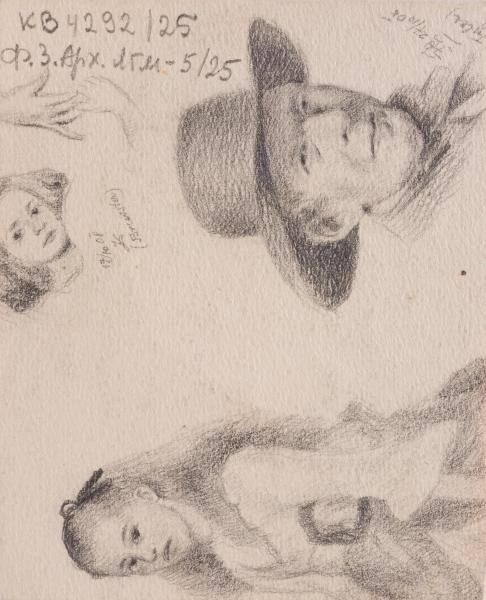
The work is an example of graphic mastery in the field of academic drawing of the early twentieth century, executed in ink with a pen. The image is presented in three-quarters, which allows the author not only to carefully reproduce the anatomical structure of the head, but also to convey the psychological state of the model through subtle nuances of facial expressions and an expressive look full of tension. The person probably belongs to the military personnel of the period of the First World War or its end – this is indicated by a characteristic helmet with a crested brim, like the one worn by Kaiser Wilhelm II, but with certain differences in decoration (it is a mistake to think that this is the so-called rickelhaube). The peculiarity of the drawing is the expressively modelled structure of the face, built almost exclusively by linear hatching. The artist skillfully uses a cross-hatch to convey volume, shadows, and textures – from the shine of the helmet's metal to the plasticity of the lips and cheekbones. The convincing light and shadow solution ensures the integrity of the image and dramatic expressiveness inherent in the portrait art of the academic school. The signature is illegible, but it can be assumed that the author was academically trained in Vienna, Budapest, or Munich, where this style of stroke modelling was part of the curriculum in graphic classes. The date on the picture – July 10, 1919 – captures the moment after the end of the war and the collapse of the Austro-Hungarian Empire, which adds a certain historical connotation to the image. The image of a soldier can be a documentary portrait rather than a generalised, almost typologised figure that captures the image of an entire era full of tension, change, and loss. At the same time, the drawing could have been part of a series of studies from other works or copies based on photographs, which were widely practised in academies as a means of training the artist's eye and hand. In general, the work is characterised by technical skill and depth of psychological insight. It combines the precision of realistic drawing with graphic expression, a characteristic of the art of the transitional period between academicism and the modernist search of the first third of the twentieth century. On the back are fragments of the study rooms: a half-figure of a girl in a dress, a pair of hands, a full-length portrait of a man wearing a hat, and a child's head.
Inscriptions
On the obverse: illegible signature; signature of Yulian Zaiats; “10/7 19”. On the reverse: “17/10 08”; signature of Yulian Zaiats; illegible inscription. “27/10/08”; signature of Yulian Zaiats; illegible inscription.
Legal regulation
Borys Voznytskyi Lviv National Art Gallery