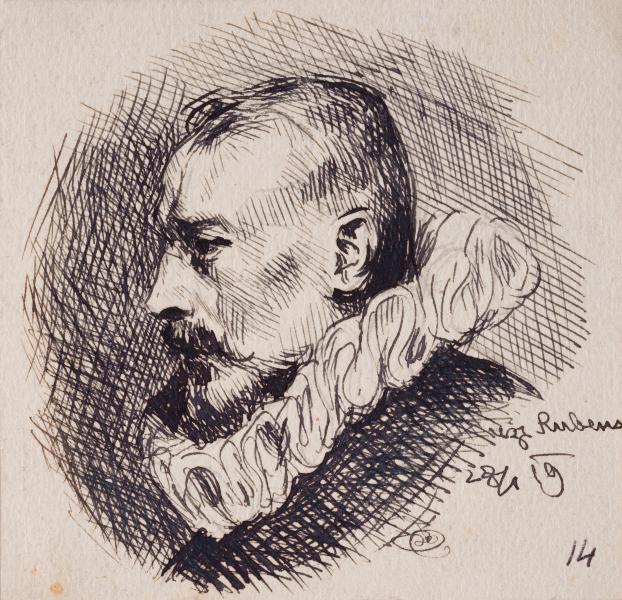
Drawing of a Man's Head
Yulian Zaiats


Basic information
- ID
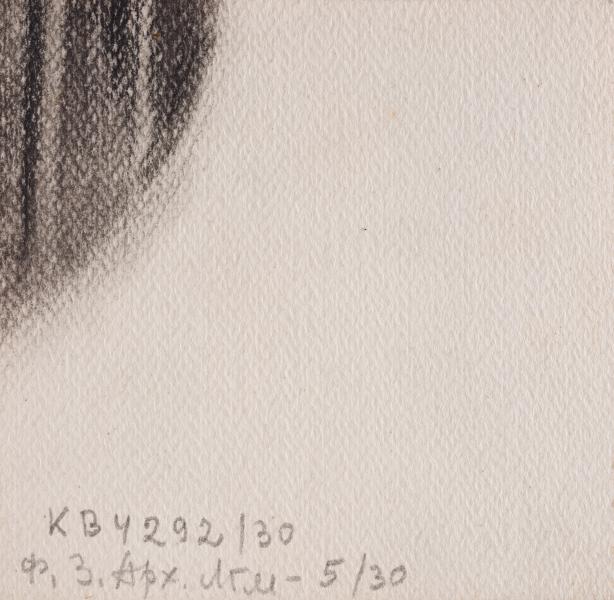
- Ф-З-Арх-ЛГМ-5/30
- Author
- Yulian Zaiats
- Name
- Drawing of a Man's Head
- Date of creation
- 28.01.1919
- Country
- the Second Polish Republic
- Technique
- drawing
- Material
- paper Indian ink
- Dimensions (height x width, cm)
- 8.7 x 9
Additionally
- Type
- graphic art
- Genre
- portraiture
- Plot
- Portrait
- Provenance
- Received from Nina Zaiats
Information about author
Object description
The portrait is a study copy executed in ink and pen, a technique typical of drawings and study sketches from the early 20th century. The image is probably a reproduction of a portrait of a young man created around 1613–1615 by the Flemish painter Peter Paul Rubens, one of the leading masters of portrait painting of the Baroque era. The copy accurately conveys the main elements of the composition, preserving the psychological depth characteristic of Rubens' images. The figure is depicted in a three-quarter pose, with its face turned in profile, conveying an expression of thoughtfulness and restrained confidence. The pen and ink technique, which involves complexity in the construction of form, requires the copyist to be extremely attentive when modelling volume, light, and shadow transitions, as well as textures, particularly in the depiction of hair, the massive white collar, and the shadows under the eyes. The smooth stroke is transformed into a linear-rhythmic structure, which requires the student to rethink the three-dimensional form through the language of black and white graphics. At the beginning of the 20th century, creating such copies was an indispensable component of art education, especially in academic schools and studios, where priority was given to in-depth study of form, plasticity, and emotional expressiveness through analytical observation and the reproduction of works by past masters. The pen and ink technique required a high level of precision and concentration, as the inability to make corrections developed confidence in the artist's hand, as well as the ability to work with contrast and conciseness of expressive means. The choice of this particular portrait by Rubens is not accidental: it combines the aristocratic restraint of the Flemish image with the sophistication of the pictorial form. Such images were especially valuable in the academic educational process, where the portrait served not only as a means of mastering composition, but also as a tool for studying the inner psychological state of a person. Thus, this drawing should be considered as an example of academic work on form, where the author combines a deep analytical approach to the original source with the technical discipline of classical graphic language. On the reverse side of the sheet, there is a fragment of an unidentified work, executed in pencil.
Inscriptions
On the front side: inscription "изъ Rubens"; "28/1 19".
Legal regulation
Borys Voznytskyi Lviv National Art Gallery