Drawings of Male and Female Heads
Yulian Zaiats


Basic information
- ID
- Ф-З-Арх-ЛГМ-5/9
- Author
- Yulian Zaiats
- Name
- Drawings of Male and Female Heads
- Date of creation
- 1911
- Country
- German Empire (?)
- Technique
- drawing
- Material
- paper pencil
- Dimensions (height x width, cm)
- 29.4 x 21
Additionally
- Type
- graphic art
- Genre
- portraiture
- Plot
- Portrait
- Provenance
- Received from Nina Zaiats
Information about author
Object description
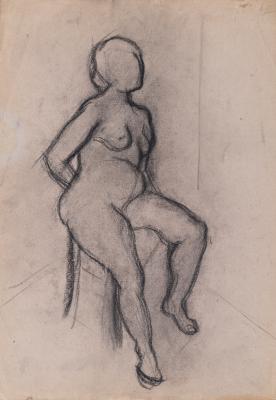
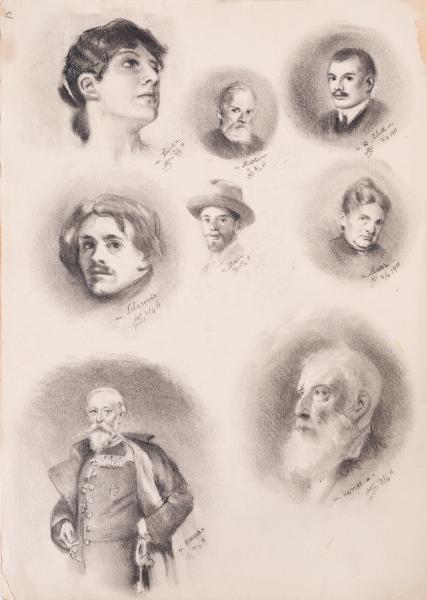
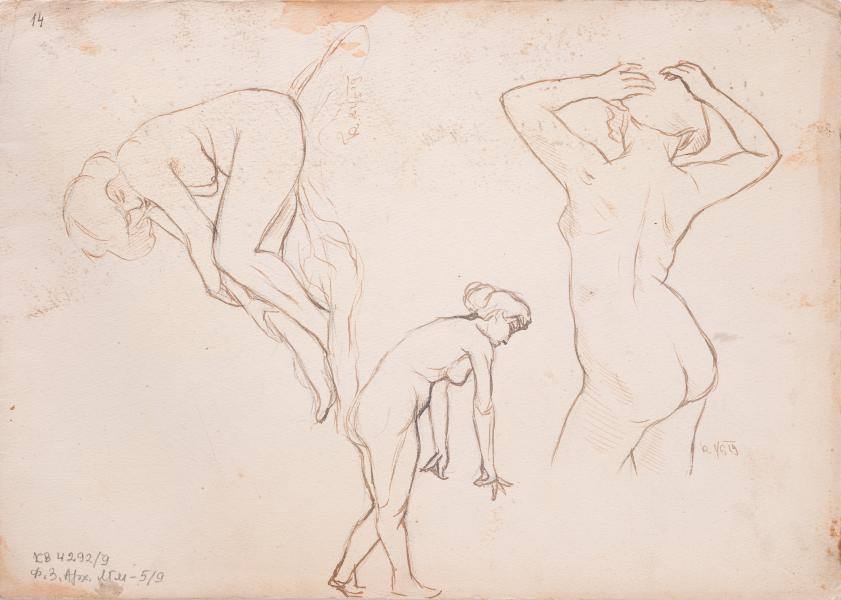
This sheet with Yulian Zaiats' sketches shows a composition from a series of graphic copies – five bust portraits and one full-length portrait, arranged in a free but harmonious order. The work is executed in pencil with skilful use of tonal transitions and sophisticated modelling of volumes. We can say that the images are collected in the style of a visual “album” – without a clear concept, but united by a theme: before us are copies of famous portraits by European artists of the 19th–20th centuries, including a self-portrait by Eugène Delacroix, interpretations of images by Carl von Marr, and representative portraits of statesmen by the artist Max Koner. Eugène Delacroix's self-portrait is presented in a manner consistent with Romanticism, with a characteristic emotional tension in the gaze, a slightly shifted composition, and active use of tone. The expression of the eyes, the expressive hairstyle, and the distinctive line of the mouth are masterfully rendered, together creating an impression of energy. Next to it are copies of portraits of Carl von Marr's parents. The male image of the artist John Marr is focused, with wrinkles, a high forehead, a somewhat stern, collected gaze, and a characteristic moustache and beard. The female portrait of Bertha Marr emphasises the oval shape of the face, serious expression of the eyes, and skilfully rendered chiaroscuro modelling. The third group of images represents the iconography of statesmen typical of official portraiture in the 19th century: carefully modelled heads in profile or three-quarter view, with individualised features – pointed noses, stern lips, and high foreheads. According to the captions, these are copies of works by Max Koner, a German portrait painter. These images emphasise both the psychological depth and symbolism of the figures depicted – Maximilian Schumann and Superintendent Hildebrandt. Overall, the composition of the sheet demonstrates not only technical skill in copying pictorial sources but also a careful reading of the stylistic features of different authors. Despite the secondary nature of the material, the graphic interpretation has its own plastic language: harmonious, balanced, executed with respect for the original. On the reverse side of the sheet, there are three figure studies of the female nude, executed in the classical academic manner. The drawings are made in ink (sepia) on paper, with an emphasis on linear clarity, proportionality, and the measured plasticity of the figure. All three poses demonstrate movement and complex angles in the context of everyday life or nature. The figure on the left is sitting, but is positioned on the sheet at a 90º angle to the others, with her head tilted and her hands touching her shins. Despite the static nature of the pose, it conveys the tension of the spine, the flexibility of the legs, and the lines of the back. The sketch is marked by attention to muscle transitions – here, anatomy is combined with a certain artistic convention: individual areas, such as the hands or feet, are marked only by light lines or omitted entirely to emphasise the overall rhythm of the body. The central female figure is half-bent, as if she has just bent down or is trying to pick something up from the floor. The composition allows us to see the body in a three-quarter turn, with a clear outline of the spine, buttocks, and tense muscles. The third figure on the right is depicted from behind and is the most massive figure in the composition. The shoulders are wide apart, both hands are behind the head – a gesture that opens up the entire back and allows the artist to carefully depict the relief of the trapezius muscles, shoulder blades, and the shape of the gluteal muscles. This pose achieves an exceptional combination of static balance and internal tension, which is revealed through the curve of the spine and the dynamics of the arms. The composition of the sheet is carefully organised – the figures do not conflict with each other. Stylistically, the work maintains the unity of hatching, lightness of contour, and minimalism. The captions and dates next to each figure indicate that they were created as part of the research process. The artist demonstrates a well-developed sense of form, the plasticity of the human body, and a deep understanding of naturalistic composition, which was important for academic art in the early 20th century.
Inscriptions
On the front, from top to bottom, left to right: illegible surname of the original author; signature of Yulian Zaiats; "2/4 11". Surname of the original author Carl von Marr; Yulian Zaiats' signature; "3/4 11". Illegible surname of the original author; Yulian Zaiats' signature; "2/4 11". Surname of the original author Eugène Delacroix; Yulian Zaiats' signature; "6/4 11". Surname of the original author Carl von Marr; Yulian Zaiats' signature; "5/4 11". Surname of the original author Carl von Marr; Yulian Zaiats' signature; "4/4 11". The surname of the original author, Max Koner; Yulian Zaiats' signature; "11/4 11". Surname of the original author, Max Koner; Yulian Zaiats' signature; "9/4 11". On the reverse: signature and "⅙ 19".
Portrayed person
- The name of the person portrayed
- John Marr, Eugene Delacroix (26.04.1798–13.08.1863), William W. Chevel, Bertha Marr, Maximilian Schumann (26.06.1827–5.09.1889), Hildebrand
Legal regulation
Borys Voznytskyi Lviv National Art Gallery