Drawings of Literary Characters
Yulian Zaiats


Basic information
- ID
- Ф-З-Арх-ЛГМ-7/12
- Author
- Yulian Zaiats
- Name
- Drawings of Literary Characters
- Date of creation
- 13.06.1962–14.06.1962
- Country
- the Ukrainian SSR
- Technique
- drawing
- Material
- paper pencil Indian ink
- Dimensions (height x width, cm)
- 20.4 x 28.5
Additionally
- Type
- graphic art
- Genre
- symbolic art
- Provenance
- Received from Nina Zaiats
Information about author
Object description
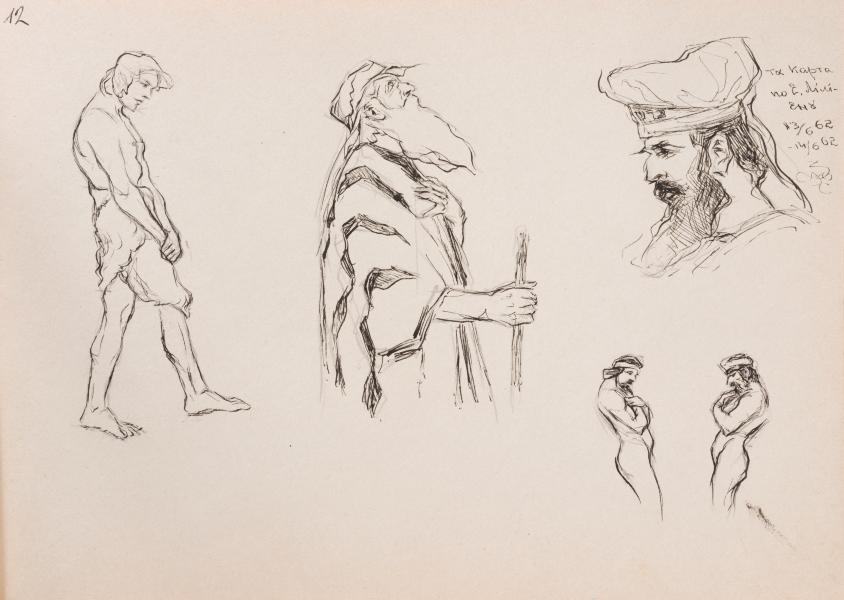
A sheet with a series of ink drawings based on the works of Ephraim Moses Lilien. The work is distinguished by its exquisite linearity, combining symbolism with the decorative rhythm of Art Nouveau. Ephraim Moshe Lilien was a Jewish artist, graphic artist, and photographer, one of the leading representatives of Art Nouveau at the turn of the 19th and 20th centuries. The artist was born in Drohobych (now Ukraine), then part of the Austro-Hungarian Empire, and his work is closely linked to the cultural renaissance of European Jewry and the Zionist movement, to which he belonged and which he actively supported artistically. Lilien's style is a subtle combination of modernism with the ornamentation of Eastern tradition and symbolism, and the figures are not just characters, but visual allegories. The figures and images are developed in a restrained but expressive manner, with an emphasis on gesture, silhouette, and spiritual mood. The composition is clearly sketch-like and exploratory, but with a clear authorial intention to comprehend the plasticity, archetypal features, and dramaturgy of the human image through the prism of E. Lilien's stylistics. Among the figures depicted, we note the half-figure of an elderly Jewish man in a prayer pose. The image is presented in profile, with his head raised, a staff in his hand, and his left hand pressed against his chest. The figure is dressed in a striped cloak that falls rhythmically in vertical lines, creating an association with a tallit. The gaze is directed upwards, and the facial features are softly generalised. The man has a long, probably grey beard, but his features are expressive, focused, immersed in prayer or inner experience. The flatness characteristic of E. Lilien is preserved, combined with the voluminous language of light and shadow in the ink. The head of a Jewish priest (?) is depicted separately, presented as an accent on the character and personality. The face is framed by a beard, the eyes are slightly raised, as if in the moment of speech or addressing the community. On his head is traditional attire, possibly a turban with an inscription in Hebrew that is difficult to read. The ink conveys the depth of his gaze, and the strong contour of his forehead and eyebrows forms the image of an inwardly focused spiritual leader. The young figure, with a physically developed torso, is depicted in a half-turn movement. His head is bowed, his hair neither long nor short, his features full of strength and calm dignity. The artist clearly articulates the structure of the body, capturing anatomical accents, but retains the decorative flatness characteristic of E. Lilien's graphics. Two naked figures of bearded men with headbands – figures turned to each other in profile – create a symmetrical composition with mirrored rhythm. They stand with their arms crossed over their chests, creating a sense of calm, strength, and inner composure. The headbands indicate a ritual or biblical subtext, possibly images of prophets or ancestors. The figures are depicted with a concentrated line, the ink modelling the volume of the body in a restrained manner, without excessive detail, yet with a clear rhythm of anatomy. Overall, the series maintains an ascetic aesthetic. All images are imbued with dignity, spiritual verticality, and restrained expression, echoing E. Lilien's stylistic code.
Inscriptions
On the right side is the inscription: "Sheet after E. Lilien"; "13/6 62–14/6 62".
Legal regulation
Borys Voznytskyi Lviv National Art Gallery