Drawing of a Rose
Yulian Zaiats


Basic information
- ID
- Ф-З-Арх-ЛГМ-7/16
- Author
- Yulian Zaiats
- Name
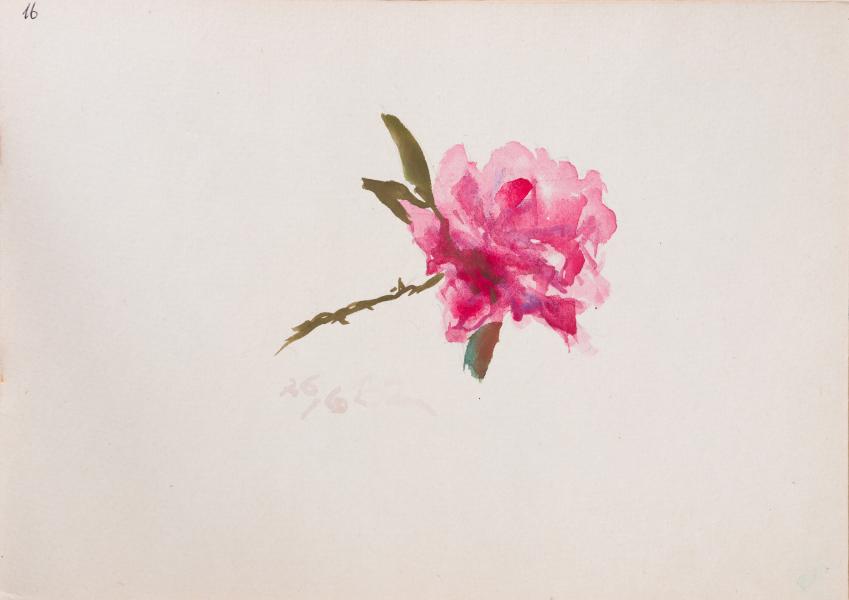
- Drawing of a Rose
- Date of creation
- 22.06.1962–23.06.1962
- Country
- the Ukrainian SSR
- Technique
- watercolour
- Material
- paper watercolour
- Dimensions (height x width, cm)
- 20.4 x 28.5
Additionally
- Type
- painting
- Genre
- still life
- Provenance
- Received from Nina Zaiats
Information about author
Object description
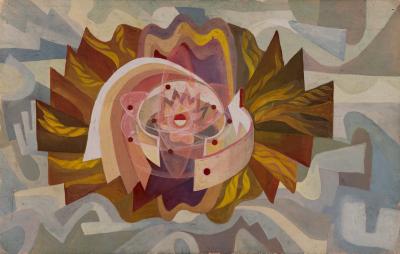
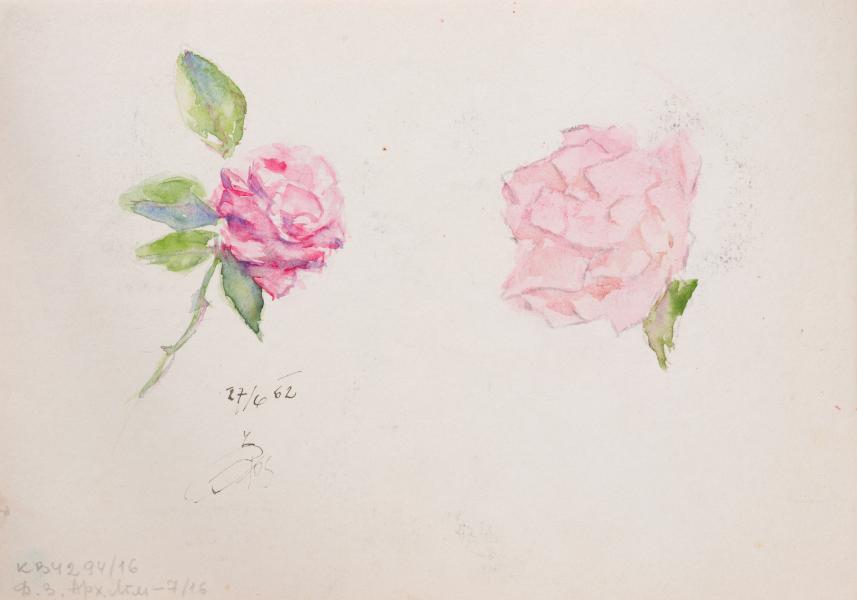
The watercolour depicting a cut rose in a horizontal position is an example of a stylised botanical composition, executed in a format similar to a graphic sketch or sketch by Y. Zaiats for a decorative vignette. The image of the rose is positioned on the surface of the sheet so that the flower lies parallel to the horizontal plane, creating a calm and balanced composition. The stem is thin, slightly curved, and the bud is fully open, yet not overloaded with detail: the shape of the petals is conveyed by light, almost transparent strokes, creating a sense of lightness and ephemerality in the image. The colour palette is muted and delicate, with an emphasis on warm pink tones characteristic of classic decorative watercolour exercises from the turn of the 19th and 20th centuries. The style of the drawing leans towards a decorative and graphic approach; it may have been created with the intention of further use as an element of ornamentation, a vignette, or an illustrative insert in the design of the text. The composition exhibits a sense of precision in the lines and a harmonious blend of flatness and spatial depth, indicating good training in drawing from life and careful observation of natural forms. At the same time, a certain conventionality of presentation, conscious stylisation, and a rejection of excessive realism indicate the author's reinterpretation of nature in the context of a decorative image. Interestingly, on the reverse side of the sheet, there are two more images of roses, probably also of a sketch nature. One of them is much more detailed: the petals have a distinct volume, the plant's structure is more accurately conveyed, and the play of light on the surface is more carefully modelled. The other flower is just a sketch, barely outlined and with a few light shadows, indicating the initial stage of working on the form. This suggests that we are looking not only at a finished decorative work, but also at a fragment of the entire process of artistic observation and study of plant forms, which involves successive stages: from a passing visual impression to a detailed study and reflection in the realm of decorative thinking. Such exercises were typical for artists who worked in the fields of book graphics, decorative album design, textile samples, or artistic modelling. The work shows the skill of a hand accustomed to working with live nature, but not for its accurate reproduction, but as a starting point for its own stylistic interpretation. It can be assumed that this watercolour was created as part of a broader study of the image of a flower as an element of symbolism, ornamentation, or visual accent in a book or decorative composition.
Inscriptions
From left to right: "26 / 6 (?)". On the reverse: "27 / 6 62"; signature of Yulian Zaiats.
Legal regulation
Borys Voznytskyi Lviv National Art Gallery