Drawings of Men's Heads
Yulian Zaiats


Basic information
- ID
- Ф-З-Арх-ЛГМ-7/18
- Author
- Yulian Zaiats
- Name
- Drawings of Men's Heads
- Date of creation
- 05.08.1962–06.08.1962
- Country
- the Ukrainian SSR
- Technique
- drawing
- Material
- paper pencil
- Dimensions (height x width, cm)
- 20.4 x 28.5
Additionally
- Type
- graphic art
- Genre
- portraiture
- Provenance
- Received from Nina Zaiats
Information about author
Object description
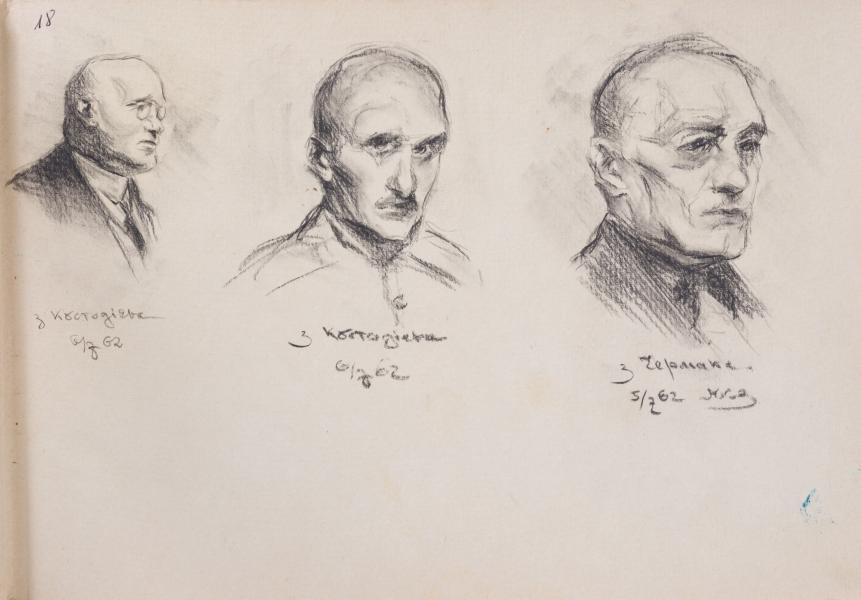
This series of drawings of three male portraits shows a thorough study of the portrait genre in its restrained but psychologically expressive approach. All images are executed in the technique of academic pencil drawing, with an emphasis on the accuracy of proportions, the modelling of form through nuanced chiaroscuro and a restrained conveyance of character. The visual similarity to early 20th-century graphic originals, primarily by Borys Kustodiev, as well as by the author Herman (?), allows these drawings to be viewed as part of a conscious artistic exploration of the stylistic features of the era. The first portrait is a drawing copy of Ihor Hrabar from a group portrait of members of the art association ‘World of Arts’ created by Borys Kustodiev. The figure is depicted in profile with a slight turn towards the viewer, which adds naturalness to the image. The facial features are carefully modelled, with particular attention to the characteristic curve of the nose, the shape of the chin, the high forehead and the roundness of the cheeks. The glasses are drawn with ease, without excessive detail, but they do not lose their expressiveness; on the contrary, they become an important detail of the image. The absence of a beard and hair gives the face clean lines and allows one to focus on the plasticity of the head itself, which is presented with the expressive mental tension characteristic of intellectual portraits of that time. The second portrait is a copy of an image by graphic artist Hryhorii Vereiskyi, also from B. Kustodiev's portrait series. Unlike the first, here the figure is positioned almost frontally, with a slight turn of the shoulders, emphasising the frontal symmetry of the composition. The hair is cut short, the face has a short dark moustache, devoid of emotion but focused. The gaze is direct but sharp. In the drawing copy, the author conveys the relief of the cheekbones and the shadows under the eyes, maintaining a fine line between portrait realism and artistic generalisation. The military uniform is barely sketched, so the main focus is on the face. The third drawing is a full-length portrait of a man in a frock coat, based on the original by the artist Herman (?). The figure is shown in three-quarter view, with the head slightly tilted forward, creating an effect of concentration. The face is beardless and moustache-less, elongated, with a high forehead, straight nose and slightly tired look. The lines of the drawing are soft but confident, with an emphasis on modelling volume through hatching, which gives the image a subtle psychological characterisation. The suit retains the austerity of silhouette characteristic of men's business attire of the late 19th and early 20th centuries. Despite the small number of details, the portrait is distinguished by its restrained expressiveness, which tends towards the images of “intimate" graphics. Overall, this series of drawing copies demonstrates not only the author's professional skills, but also his analytical attention to facial features, the rhythm of lines, composition and visual psychology. It may be part of the research process of an artist who sought to interpret the portrait in a spirit of restraint, with attention to internal statics, concentration, and character without decorative excess. Such a study is undoubtedly an important link in the evolution of the artist's own creative language.
Inscriptions
From left to right: "From Kustodiev"; "6/8 62"; "From Kustodiev"; "6/8 62"; "From Herman (?)"; "5/8 62"; signature of Yulian Zaiats.
Portrayed person
- The name of the person portrayed
- Ihor Hrabar (25.03.1871–16.05.1960), Hryhorii Vereiskyi (18(30).06.1886–18(19).12.1962)
Legal regulation
Borys Voznytskyi Lviv National Art Gallery