Decorative Altar Top (God the Father)
unknown


Basic information
- ID
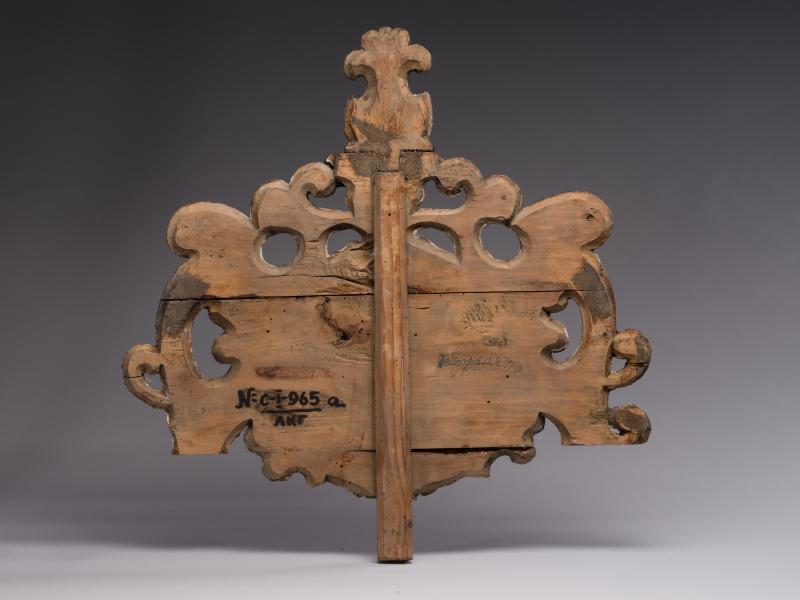
- С-I-965.а
- Author
- unknown
- Name
- Decorative Altar Top (God the Father)
- Date of creation
- 18th c.
- Country
- Ukraine
- Technique
- carving polychrome
- Material
- wood
- Dimensions (height x width, cm)
- 54 x 60
Additionally
- Type
- decorative and applied arts
- Genre
- religious
- Provenance
- Teisariv village, Stryi district, Lviv region
Information about author
Object description
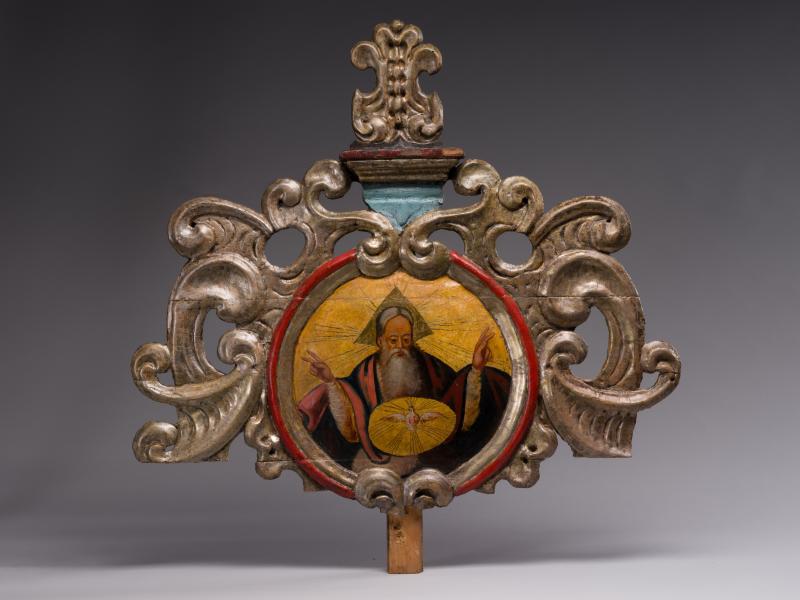
The altar finial is the culminating accent of the sacred ensemble, completing the composition and directing people's gaze upwards. The work is executed in the Baroque style. The richness of swirls and stylised carved elements creates a sense of movement and elevation. The master skilfully combines carving and painting, giving the finial decorative expressiveness. The balanced composition of the work, with a clear emphasis on the central image, is distinguished by the harmony of proportions, the plasticity of lines, and the spiritual expression of the pictorial image. The figure of God the Father is placed in a round medallion. In his work, the master used soft modelling of volume, thanks to which the silhouette of the saint acquires a lively expressiveness while retaining its idealised character. The figure of God the Father is depicted in a cherry-coloured himation with raised hands. He is depicted as a grey-haired old man with a long beard, symbolising his eternity and wisdom. His facial features are rendered with calm severity, but without excessive harshness. Above the head of the divine Father is a triangular halo from which rays of light emanate. It signifies absolute power and the top of the pyramid. To enhance the effect of the rays, the master used gilding. The finial of the altar not only serves a decorative function, but also symbolises the supremacy of God the Father.
Legal regulation
Borys Voznytskyi Lviv National Art Gallery