Collection of Ethnographic Drawings
Kajetan Kielisinski

Basic information
- ID
- Г-V-424_125
- Author
- Kajetan Kielisinski
- Name
- Collection of Ethnographic Drawings
- Country
- Kingdom of Poland
- Culture
- Modern times
- Technique
- drawing
- Material
- pencil
Additionally
- Type
- graphic art
- Genre
- genre art
- Provenance
- the Dzieduszycki collection
Information about author
Object description
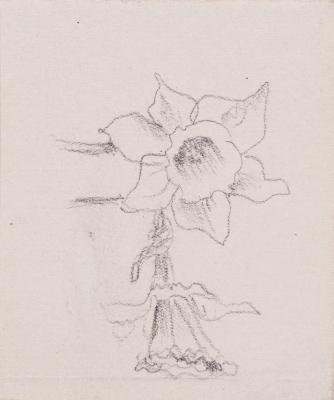
Kajetan Wincenty Kielisiński created numerous etchings and drawings devoted to folklore, life in Polish villages and towns, historical monuments, and landscapes. He was one of the first to develop bookplates in Poland. During his travels to various locations, he collected graphic materials for the publications "Polish Antiquities" and "Folk Costumes". In 1855, Poznań publisher Jan Konstanty Żupanski published "Kielisiński's Album", which collected the artist's scattered works. Kielisiński's graphic works, drawings, sketchbooks, and correspondence were kept in the Kórnik Library of the Polish Academy of Sciences, as well as in national museums (Kraków, Poznań, Warsaw) and renowned libraries (Jagiellonian University, Ossolineum, Warsaw University). The image shows a graphic drawing executed in a linear manner, with minimal hatching. The central figure is a man dressed in long, loose-fitting clothes and a headdress resembling a simple cap or hat. He is wearing boots and a wide belt over his clothes. He is standing next to large sacks and holding a wooden barrel or basket filled with items, possibly firewood. His hands are busy transferring these items to the basket. In the background, you can see a brick wall and the outlines of another city building, so the background does not distract from the figure of the man but, on the contrary, emphasises it. The manner of depiction is quite restrained, focusing on an everyday scene where the man is shown as a servant or merchant, clearly from the lower strata of the urban population. His posture is simple, his expression calm, but somewhat tired, perhaps sad, which emphasises the nature of his daily hard work. The composition is restrained, without excessive detail, but well organised: the large sacks balance the vertical figure and form a coherent scene. Such images are significant not only as works of art but also as ethnographic and socio-historical sources, preserving an idea of the lives of ordinary people of a certain era, including their clothing, occupations, and living conditions. Since the drawing accurately reflects and conveys the details and features of the folk clothing of a particular region, it has a pronounced ethnographic, historical, and cultural value. Its artistic significance lies in the accurate and detailed reproduction of folk costumes, making it a valuable source for research and study of traditional culture. From an aesthetic point of view, we are dealing with a realistic drawing, with a special emphasis on its documentary nature.
Legal regulation
Borys Voznytskyi Lviv National Art Gallery