Collection of Ethnographic Drawings
Kajetan Kielisinski

Basic information
- ID
- Г-V-424_144
- Author
- Kajetan Kielisinski
- Name
- Collection of Ethnographic Drawings
- Country
- Kingdom of Poland
- Culture
- Modern times
- Technique
- drawing
- Material
- pencil
Additionally
- Type
- graphic art
- Genre
- genre art
- Provenance
- the Dzieduszycki collection
Information about author
Object description
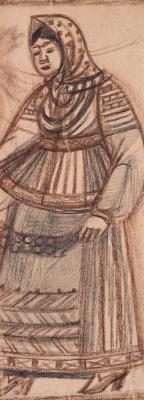
Kajetan Wincenty Kielisiński created numerous etchings and drawings devoted to folklore, life in Polish villages and towns, historical monuments, and landscapes. He was one of the first to develop bookplates in Poland. During his travels to various locations, he collected graphic materials for the publications "Polish Antiquities" and "Folk Costumes". In 1855, Poznań publisher Jan Konstanty Żupanski published "Kielisiński's Album", which collected the artist's scattered works. Kielisiński's graphic works, drawings, sketchbooks, and correspondence were kept in the Kórnik Library of the Polish Academy of Sciences, as well as in national museums (Kraków, Poznań, Warsaw) and renowned libraries (Jagiellonian University, Ossolineum, Warsaw University). The drawing depicts a woman of noble birth in festive or ceremonial attire. The figure stands in a calm pose, her hands folded in front of her. She is dressed in a long, luxurious robe or outer cloak or mantle with large sleeves flared at the bottom. It is embroidered with a pattern resembling plant or floral motifs. Underneath the outer garment, a striped element of the costume is visible, probably a dress or tunic, which is slightly lighter and has a geometric pattern. On her head is a round cap with an embroidered or decorated pattern, from under which long hair falls. She is wearing soft boots or shoes with raised toes, possibly sandals, characteristic of the wealthy classes. The background features a carefully paved brick or stone floor and, most likely, columns, which add spatial depth to the scene and hint at a palace interior or a ceremonial place. The image is executed in a graphic manner: a thin, neat line drawing without colour, with attention to the ornament's details and the fabric's texture. The figure is conveyed statically and balanced, emphasising the grandeur and solemnity of the clothing. The artistic value of the drawing lies in its documentary and ethnographic accuracy in depicting the historical costume: the author sought to capture the details of the clothing and social image, rather than the individual features of the person.
Legal regulation
Borys Voznytskyi Lviv National Art Gallery