Collection of Ethnographic Drawings
Kajetan Kielisinski

Basic information
- ID
- Г-V-424_354
- Author
- Kajetan Kielisinski
- Name
- Collection of Ethnographic Drawings
- Country
- Kingdom of Poland
- Culture
- Modern times
- Technique
- drawing
- Material
- pencil
Additionally
- Type
- graphic art
- Genre
- genre art
- Provenance
- the Dzieduszycki collection
Information about author
Object description
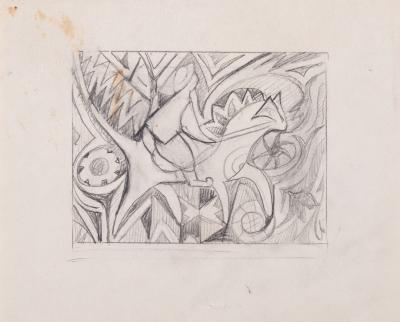
Kajetan Wincenty Kielisiński created numerous etchings and drawings devoted to folklore, life in Polish villages and towns, historical monuments, and landscapes. He was one of the first to develop bookplates in Poland. During his travels to various locations, he collected graphic materials for the publications "Polish Antiquities" and "Folk Costumes". In 1855, Poznań publisher Jan Konstanty Żupanski published "Kielisiński's Album", which collected the artist's scattered works. Kielisiński's graphic works, drawings, sketchbooks, and correspondence were kept in the Kórnik Library of the Polish Academy of Sciences, as well as in national museums (Kraków, Poznań, Warsaw) and renowned libraries (Jagiellonian University, Ossolineum, Warsaw University). The picture shows a man standing full-length against a brick wall. The figure is depicted in traditional attire characteristic of the Cossack or bourgeois milieu of the 17th–18th centuries. The outer garment is a long-tailed żupan or an overcoat, fitted at the top, with pronounced voluminous sleeves that are slightly gathered in folds at the elbows. A row of buttons and fasteners can be seen at the front, running along the chest to the waist. This cut emphasises the figure and creates a sense of severity. The hem is wide, flared, and resembles a skirt, falling almost to the ankles and forming vertical folds that create an impression of the figure's massiveness and monumentality. The collar is low and stand-up, a typical feature of żupans and Cossack clothing. The sleeves are voluminous and long, with cuffs that protrude slightly and are clearly defined by a line. The man is wearing low boots or postoly (traditional Ukrainian leather shoes) that fit the foot, without high shafts and with a slight rise. The trousers are practically invisible under the long hemline, but it is clear that they are narrow and tucked into the shoes. Overall, the outfit combines restraint and solemnity. Such clothing indicates membership of the wealthier strata of society, as ordinary peasants wore simpler coats or sheepskin coats. The left hand is held at the waist, while the right is raised to the face, holding the fingers near the mouth or chin, or stroking the elegant moustache, creating an impression of thoughtfulness or reflection. The man's face has clear features, his hair is short, and he probably has a Cossack chub. His figure is drawn with attention to detail – you can see the folds in his clothes and shoes, as well as the texture of the fabric. Architectural elements, including stones in the wall, a fragment of a building, and vegetation, complement the background. The drawing's style is restrained, with precise lines and no excessive ornamentation. The image serves as an excellent example of the traditional clothing and appearance of a representative of a particular era. Its artistic significance lies in the accurate and detailed reproduction of folk attire, making it a valuable source for research and study of traditional culture. From an aesthetic point of view, we are dealing with a realistic drawing, with a special emphasis on its documentary nature.
Legal regulation
Borys Voznytskyi Lviv National Art Gallery