Crucifix
Jan Obrocki


Basic information
- ID
- С-I-1948
- Author
- Jan Obrocki
- Name
- Crucifix
- Country
- Ukraine
- Technique
- carving polychromy
- Material
- wood
- Dimensions (height x width, cm)
- 258 x 174
Additionally
- Type
- sculpture
- Genre
- religious
- Plot
- Crucifixion
- Provenance
- Busk town, Busk district, Lviv region, St. Stanislaus Church
Information about author
Object description
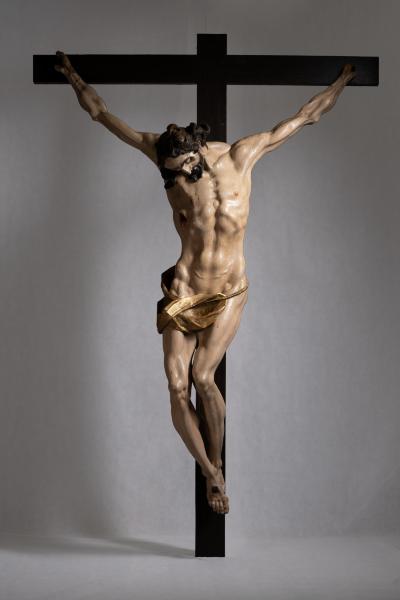
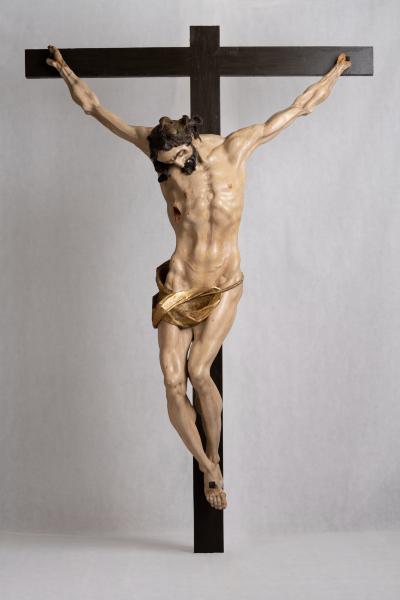
Around 1779, Jan Obrocki and Ignat Buraczynski made a three-dimensional sculpture of the high altar and pulpit for the Church of St. Stanislaus in Busk. The size of the crucifix from the altar composition was impressive. In all Byzantine monuments, Christ is nailed to the cross with four nails; this iconography remained unchanged in the Latin Church. The Gothic style made changes – Jesus was depicted as nailed with three nails, the majestic and serene state of the saint acquired a naturalistic expression, and the Baroque style added emphatic expression and dynamism to the image. The crucifix from Busk Church shows the exhausted figure of the crucified Jesus on the cross. The body's structure is detailed: thin, muscular arms and legs, a chest with protruding ribs and a spear mark. The main attention is focused on Christ's face: his head is lowered to his chest, his eyebrows are drawn together, his eyes are closed, his nose is elongated and straight, and black strands of hair and beard fall on his chest. The sculpture is characterised by a high degree of emotionality and realism.
Legal regulation
Borys Voznytskyi Lviv National Art Gallery