Portrait of an Unknown Man

Jan Kupecky

  • Portrait of an Unknown Man 2
  • Portrait of an Unknown Man 3
  • Portrait of an Unknown Man 4
  • Portrait of an Unknown Man 5
  • Portrait of an Unknown Man 6
  • Portrait of an Unknown Man 7
Basic information
ID
Ж-1257
Author
Jan Kupecky
Name
Portrait of an Unknown Man
Technique
oil painting
Material
canvas oil
Dimensions (height x width, cm)
64.8 x 48.5
Additionally
Information about author
Author
Jan Kupecky
Artist's lifetime
1667–1740
Biography
Jan Kupecky (1667–1740) was a Czech and Slovak artist, a representative of historical and portrait painting of the Baroque period in Central Europe. He worked and lived in Italy, Germany, Hungary, the Czech Republic, Austria, and Slovakia. He received his artistic education in Slovakia (then part of the Kingdom of Hungary). In the spring of 1682, Jan travelled to Lucerne, Switzerland, to study painting. He was taught by the artist Benedikt Klaus, who worked in both Vienna and the Kingdom of Hungary. During this time, Jan Kupecky focused on portraits, copying the works of Carl Loth. He was greatly influenced by the works of Rembrandt, Guido Reni, and Caravaggio. Once he had gained technical skills after several years of studying under Klaus, around 1685, Kupecky travelled to Italy to study. He worked as a free artist in Rome for over 22 years. There he gained recognition, praised by Prince Aleksander Benedykt Sobieski, son of Polish King Jan III Sobieski. Around 1708–1709, at the order of Prince Adam of Liechtenstein, Kupecky returned to Austria and settled in Vienna. For his portraits, he soon became a favourite of Emperor Leopold I and Joseph I and, thus, of the entire Viennese nobility. In 1723, fearing religious persecution, Kupecky fled from Vienna to Nuremberg with his family and worked there until he died in 1740. Jan Kupecky's works include historical paintings, landscapes, and numerous portraits, which granted him high acclaim ("Portrait of Peter I", "Portrait of Prince Eugene of Savoy", "Portrait of King Jan III Sobieski of Poland"). The artist also created several portraits with musical instruments ("Portrait of a Woman with a Viola d'Amore", "Portrait of David Hojer with a Lute") and self-portraits ("Self-Portrait while Creating the Image of Eugene of Savoy", "Self-Portrait with the Son"). As the most prominent portraitist in Germany, he received commissions from many princes, wealthy church figures, and scholars. Thanks to his students and followers, Kupecky's influence and artistic example remained relevant for a long time.
Object description
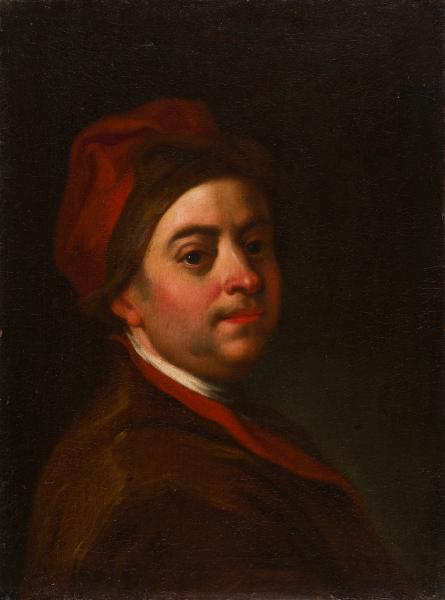
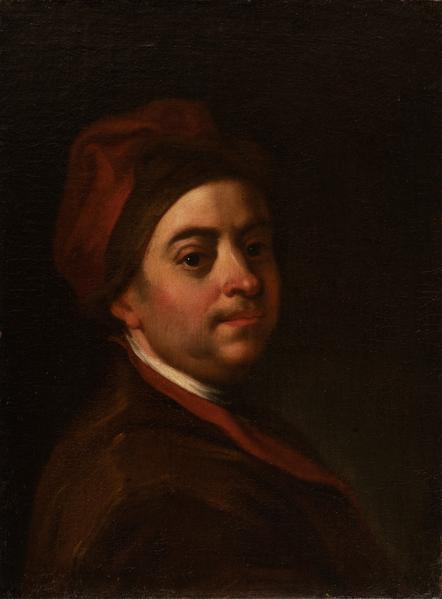
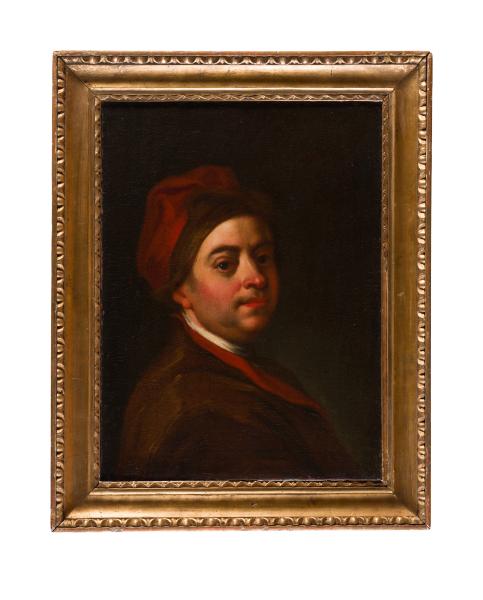
As the most significant portraitist of his time, Jan Kupecky received commissions from many prominent, wealthy and less privileged people. His clients included rulers, princes, church figures, scholars, and ordinary citizens. The portrait depicts an unknown man in a subdued colour scheme. Against a dark brown-greenish background, the bust-length figure is depicted with his body turned to the right while his gaze is directed at the viewer. The man is dressed in the bourgeois attire of Central and Eastern Europe of that time. He wears a red beret, a brown coat with a red collar, and a white scarf around his neck. In a plane graphic manner, the portrait features of the man are depicted in detail.
Legal regulation
Borys Voznytskyi Lviv National Art Gallery