Original Sin
Arnold Sharhorodskyi


Basic information
- ID
- Ф.Шар.Арх.ЛКГ-28
- Author
- Arnold Sharhorodskyi
- Name
- Original Sin
- Date of creation
- 1971
- Country
- the USSR
- Culture
- Art of the Soviet period
- Technique
- oil painting
- Material
- canvas oil
- Dimensions (height x width, cm)
- 99 x 73
Additionally
- Type
- painting
- Genre
- symbolic art
- Plot
- Allegory
- Provenance
- Handed over to the museum from Arnold Sharhorodskyi
Information about author
Object description
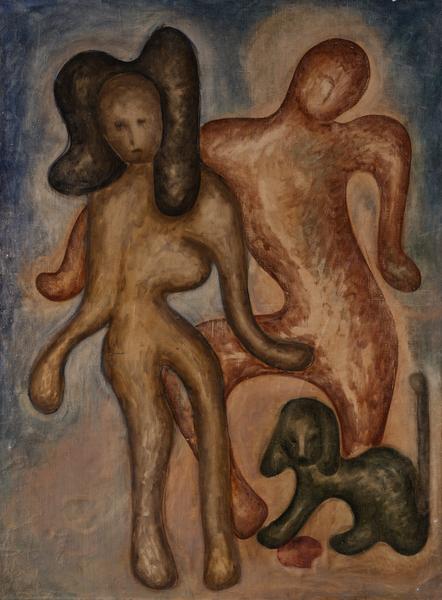
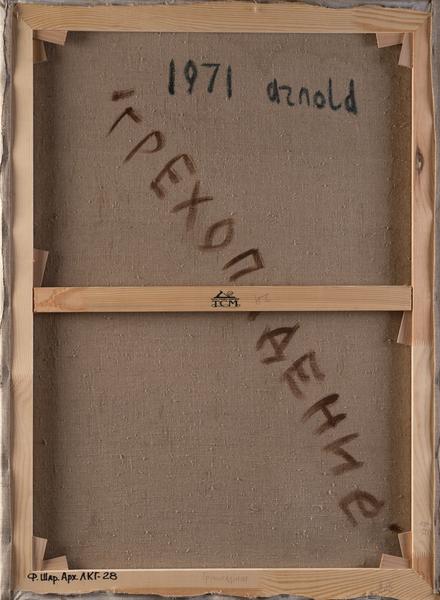
Against a light background divided into symbolic representations of the grey-blue sky and ochre ground, two stylised figures are depicted: a nude woman with a lush hairstyle and a man, turned to the viewer, standing next to her. The man's body is dark in colour, as in the practice of Minoan murals. The woman's left hand is placed in the male figure's groin area, but there are no indications of primary sexual characteristics in either of them. The woman has stylised but expressive mammary glands. There is a small dog at the man's feet. This composition is probably an analogy to Jan van Eyck's famous work "The Arnolfini Portrait" (1434). However, while the subject of van Eyck's painting is often interpreted as a marriage contract signing, with the dog symbolising marital fidelity, Arnold Sharhorodskyi introduces an entirely different narrative, labelling his canvas as "Грехопадение" (Original Sin). Whether this is a question of insincerity or hypocrisy on the part of one or both characters, or whether the author interprets the problem of failure (Greek ἁμαρτία, "sin", is identical to the expression "miss the mark") differently, is challenging to establish. The artwork's stylistic exhibits a formal approach often employed by the artist in his American period artworks. There is room for allusions to Marc Chagall's practices (such as "Song of Songs II", 1957) and the exploration of corporeality in the drawings of Henry Moore and Henri Matisse paintings.
Legal regulation
Borys Voznytskyi Lviv National Art Gallery