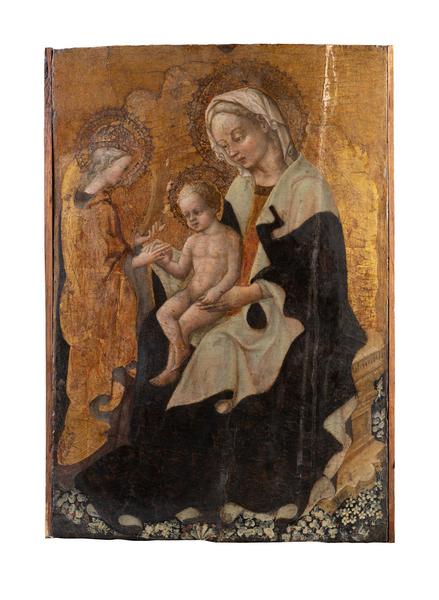
Madonna with Child and Saint Catherine
Circle of Gentile da Fabriano (Umbrian School)


Basic information
- ID
- Ж-752
- Author
- Circle of Gentile da Fabriano (Umbrian School)
- Name
- Madonna with Child and Saint Catherine
- Date of creation
- 15th c.
- Technique
- tempera painting
- Material
- wood tempera
- Dimensions (height x width, cm)
- 56 x 39.5
Additionally
- Type
- painting
- Genre
- religious
- Plot
- Madonna. The Virgin Mary and Christ Child
- Provenance
- Collection of Lviv City Gallery
- Exposition
- Potocki Palace
Information about author
Object description
The Umbrian School's name comes from the Umbria region, the centre of which was Perugia city. In the late 14th – early 15th centuries, the School masters worked in the late Gothic Italian art traditions. From the second half of the 15th century, the School masters' artworks started reflecting early Renaissance principles. The most renowned and significant representatives of the Umbrian School in Renaissance art are Raphael Santi, Pietro Perugino, Bernardino Pinturicchio, Lo Spagna, Federico Barocci, Antonio Alberti, Timoteo Viti, Benozzo Gozzoli, Giovanni Boccaccio, Gentile da Fabriano, Fiorenzo di Lorenzo, Francesco Melanzio, and Melozzo da Forli. The art of Umbria was decorative, elaborate, lyrical, imaginative, and deeply religious. In contrast to the art of Tuscany, it strongly focused on colouring. On the canvas, among the flowers, Mary sits on a low stone throne with the Child on her lap, turned three-quarters to the left. Her golden dress is visible from beneath a brown-green cloak with a bright green lining. On the left side, Saint Catherine is depicted turned to the right, holding a wheel in one hand and Christ's hand in the other. The figure of Saint Catherine is proportionally smaller than those of Mary and Jesus. She is entirely dressed in golden robes, almost merging into the canvas background.
Legal regulation
Borys Voznytskyi Lviv National Art Gallery