"The Passion of Christ" Iconostasis: The Resurrection of Lazarus, Christ's Entry into Jerusalem, Washing of the Feet, Prayer in the Garden of Gethsemane
unknown


Basic information
- ID
- Ж-4135
- Author
- unknown
- Name
- "The Passion of Christ" Iconostasis: The Resurrection of Lazarus, Christ's Entry into Jerusalem, Washing of the Feet, Prayer in the Garden of Gethsemane
- Date of creation
- early 18th c.
- Country
- Ukraine
- Culture
- Rybotytska School
- Technique
- tempera painting
- Material
- wood tempera
- Dimensions (height x width, cm)
- 112 x 218
Additionally
- Type
- icon
- Genre
- religious
- Plot
- The Passion of Christ
- Provenance
- Semenivka village, Lviv region
Information about author
Object description
"The Passion of Christ" is an iconostasis of the 17th – early 18th century consisting of a series of monumental multi-plot icons that should be viewed from top to bottom, in rows from left to right. The work's composition is distinguished by a large number of iconographic images with multi-figure scenes: 25 horizontally elongated Gospel scenes that tell us about the last days of Christ's earthly life. The four canonical scenes are part of a monumental painting composition belonging to the brush of the Rybotytska School painter. The multi-figure scenes are based on Western European models incorporated into Ukrainian art, mainly through engraving.
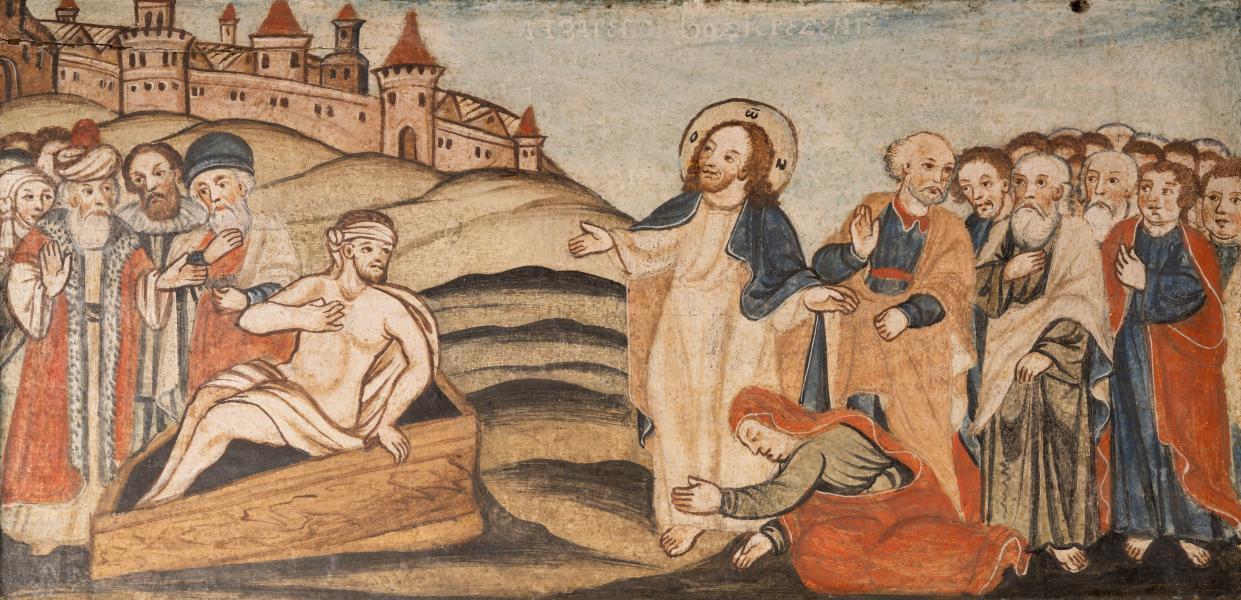
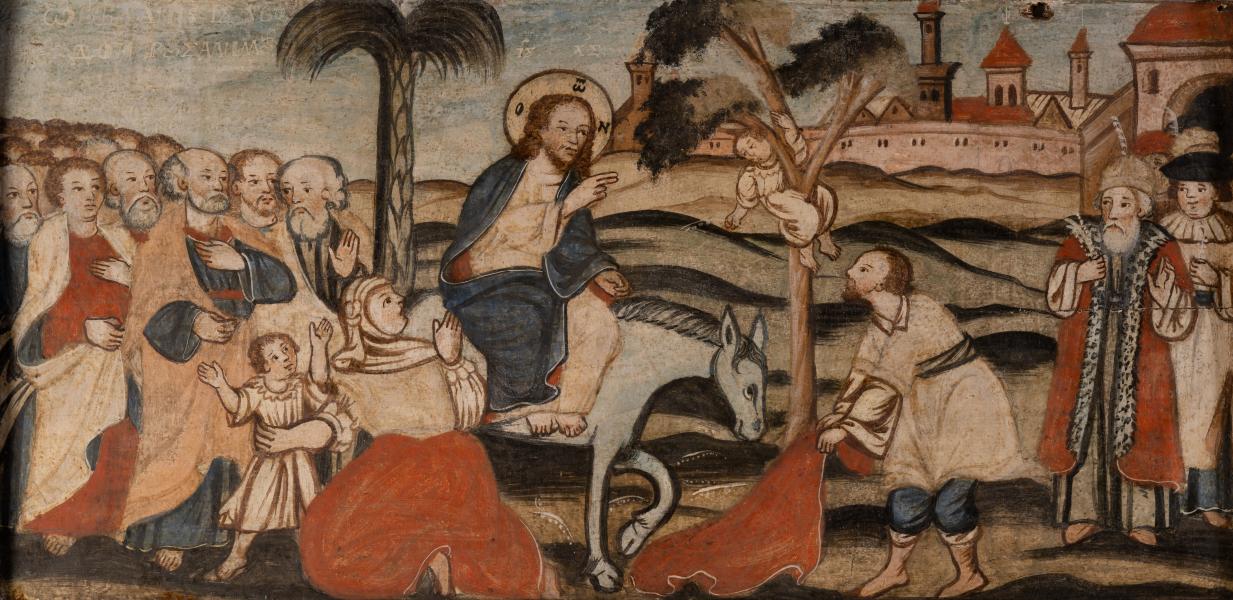
The iconographic "Resurrection of Lazarus" scene depicts Jesus addressing Lazarus, blessing the man with His right hand. The multi-figure painting depicts the pivotal moment against the backdrop of an architectural staffage. This scene is placed in the upper horizontal row of the work; behind it is the "Christ's Entry into Jerusalem" scene. On ancient icons, the Passion of Christ scenes begin with this episode as it contrasts the subsequent sad events. According to Zechariah's prophecy, Jesus was greeted as a king, a ruler who brings freedom, but in less than a week, the crowd shouted: "Crucify Him!". The scene is shown in a rocky landscape against a backdrop of city walls and architectural buildings. People spread their clothes in front of Christ, riding on a donkey, and respectable citizens meet him at the city walls. Behind the Saviour is a group of apostles who are discussing something lively. Peter is the first to be seen in the crowd with his hand outstretched towards the Saviour. In the canonical scheme, the author included elements from his native culture: local colour, architecture, and clothing. In the multi-figure fragment "Christ's Entry into Jerusalem", the icon painter depicted a typical Galician suburb and a nobleman in clothes decorated with sable fur, an element typical of the nobility.
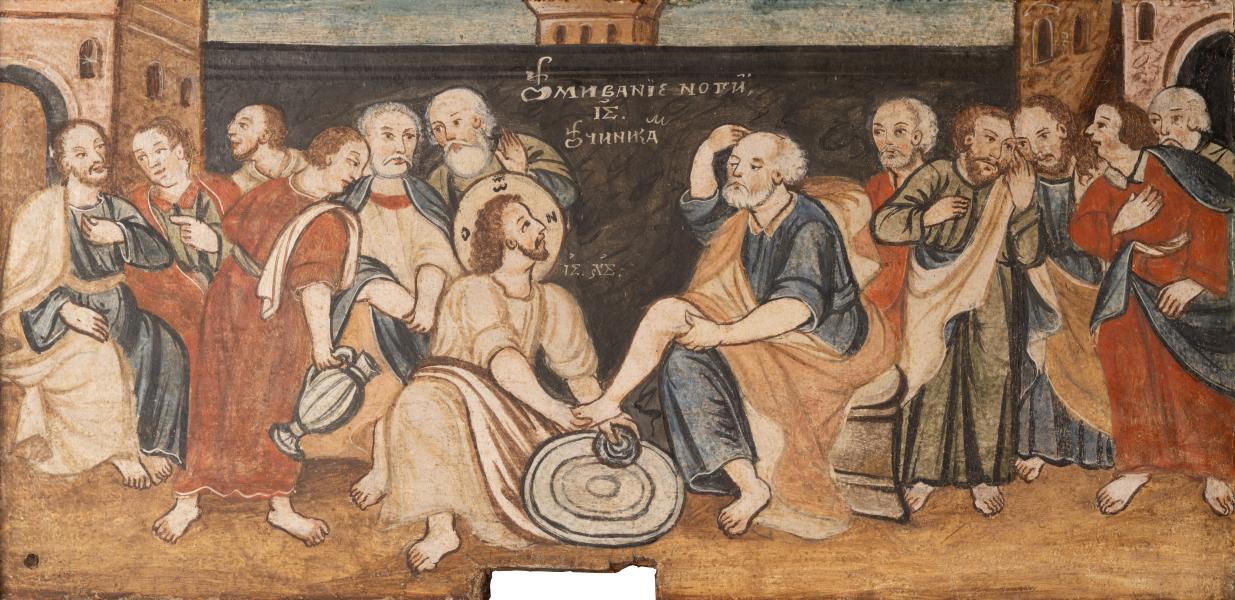
The "Washing of the Feet" scene depicts the apostles whose feet are washed by Jesus before the Last Supper on Holy Thursday. The compositional emphasis of the fragment is Christ washing the feet of the Apostle Peter. The scene is lively and emotional and is distinguished by the planar representation of figures. The dark graphic contour line plays an important role in the image.
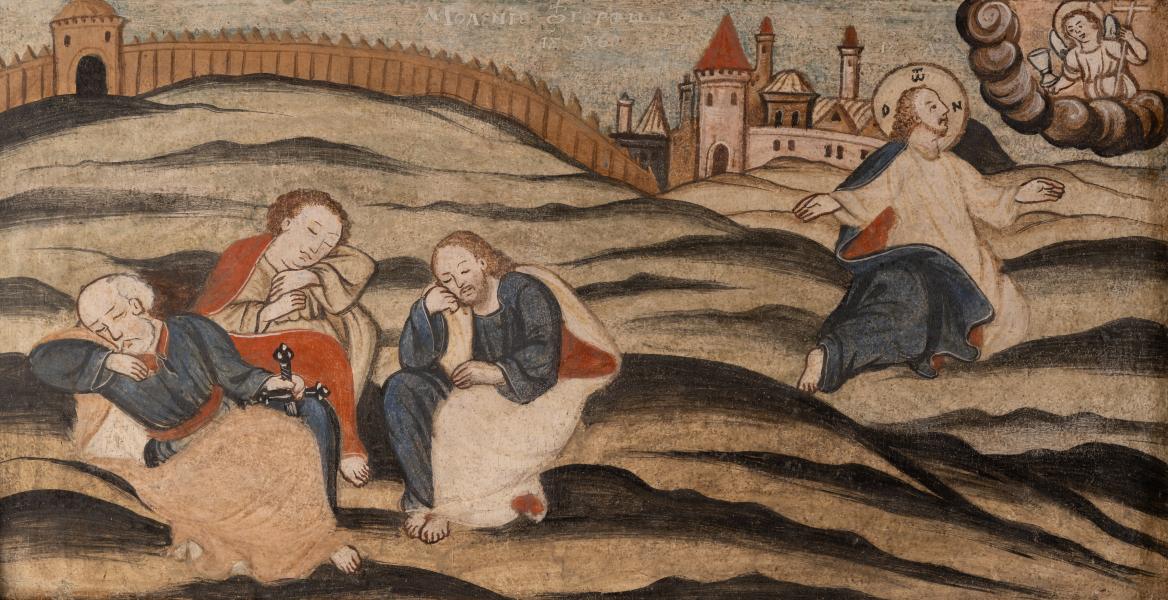
The "Prayer in the Garden of Gethsemane" scene is an iconographic story that tells how Christ, accompanied by Peter, James, and John, went to the garden and prayed fervently: "My Father, if it is possible, let this cup of suffering be taken away from Me... Yet not as I will, but as You will..." (Matthew 26:39). The action takes place against the backdrop of a city wall with architectural structures on the ground that imitates a mountainous area.
One of the characteristic features of the Rybotytska School painters, which can be traced in this work, is the inscriptions explaining the plot. The images are distinguished by an expressive pattern and a bright range of local colours, which are mainly in the ratio of white and olive green, grey-blue, and red.
The iconographic "Resurrection of Lazarus" scene depicts Jesus addressing Lazarus, blessing the man with His right hand. The multi-figure painting depicts the pivotal moment against the backdrop of an architectural staffage. This scene is placed in the upper horizontal row of the work; behind it is the "Christ's Entry into Jerusalem" scene. On ancient icons, the Passion of Christ scenes begin with this episode as it contrasts the subsequent sad events. According to Zechariah's prophecy, Jesus was greeted as a king, a ruler who brings freedom, but in less than a week, the crowd shouted: "Crucify Him!". The scene is shown in a rocky landscape against a backdrop of city walls and architectural buildings. People spread their clothes in front of Christ, riding on a donkey, and respectable citizens meet him at the city walls. Behind the Saviour is a group of apostles who are discussing something lively. Peter is the first to be seen in the crowd with his hand outstretched towards the Saviour. In the canonical scheme, the author included elements from his native culture: local colour, architecture, and clothing. In the multi-figure fragment "Christ's Entry into Jerusalem", the icon painter depicted a typical Galician suburb and a nobleman in clothes decorated with sable fur, an element typical of the nobility.
The "Washing of the Feet" scene depicts the apostles whose feet are washed by Jesus before the Last Supper on Holy Thursday. The compositional emphasis of the fragment is Christ washing the feet of the Apostle Peter. The scene is lively and emotional and is distinguished by the planar representation of figures. The dark graphic contour line plays an important role in the image.
The "Prayer in the Garden of Gethsemane" scene is an iconographic story that tells how Christ, accompanied by Peter, James, and John, went to the garden and prayed fervently: "My Father, if it is possible, let this cup of suffering be taken away from Me... Yet not as I will, but as You will..." (Matthew 26:39). The action takes place against the backdrop of a city wall with architectural structures on the ground that imitates a mountainous area.
One of the characteristic features of the Rybotytska School painters, which can be traced in this work, is the inscriptions explaining the plot. The images are distinguished by an expressive pattern and a bright range of local colours, which are mainly in the ratio of white and olive green, grey-blue, and red.
Legal regulation
Borys Voznytskyi Lviv National Art Gallery