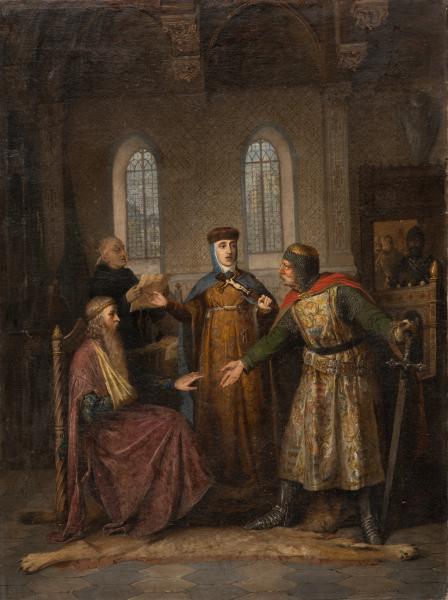
Saint Hedwig of Silesia Reconciles Konrad of Masovia with Her Husband Henry the Bearded
Aleksander Lesser



Basic information
- ID
- Ж-1791
- Author
- Aleksander Lesser
- Name
- Saint Hedwig of Silesia Reconciles Konrad of Masovia with Her Husband Henry the Bearded
- Date of creation
- 1848–1850
- Country
- Poland
- Technique
- oil painting
- Material
- canvas oil
- Dimensions (height x width, cm)
- 116 x 87
Additionally
- Type
- painting
- Genre
- history painting
- Plot
- Saint Hedwig of Silesia
- Provenance
- Collection of Lviv City Gallery
Information about author
Object description
The artist's deep interest in Poland's past resulted in numerous paintings where he recreated significant events in Polish history with exceptional knowledge and accuracy. One of these events, which took place in Plock in 1229, was depicted by the artist in the work "Saint Hedwig of Silesia Reconciles Konrad of Masovia with Her Husband Henry the Bearded". The painting is a vivid example of academic painting. The subject matter of the work concerns the dispute between Duke Henry of Wroclaw and Duke Konrad of Masovia over the supremacy of the Duchy of Krakow in 1229. Wishing for a peaceful resolution to the conflict and the release of her husband Henry, who Konrad had captured, Hedwig travels to Plock, where, after promising to marry off two of her daughters to Konrad's sons, she negotiates a peace agreement. This is the moment depicted in the painting. The scene occurs in a Gothic hall with two tall windows and a bear skin on the floor. The main characters are positioned at the centre of the composition. On the left, Henry the Bearded sits in a carved wooden chair, dressed in violet attire with his right arm bandaged. On the right, Konrad of Masovia stands leaning on a sword dressed in chainmail and an embroidered surcoat. Warriors can be seen behind him in the darkness of the doorway. The princes extend their hands to each other as a sign of truce. Between them stands Hedwig of Silesia, holding a cross in her left hand, wearing a princely fur hat over a blue veil. With her right hand, she points to the monk reading the terms of the agreement while looking anxiously at Konrad, fearing that he might change his mind.
Inscriptions
On the reverse of the stretcher, there is an inscription: "Lesser Aleksander".
Portrayed person
- The name of the person portrayed
- Hedwig of Silesia (Hedwig of Andechs) (c. 1174–1243) was a Polish saint, princess, and the wife of Henry I the Bearded. Founder of the Cistercian Monastery in Trzebnica. Patroness of orphans, spouses, and Christian families.
- Lifetime of the person portrayed
- c. 1174–1243
Legal regulation
Borys Voznytskyi Lviv National Art Gallery