Composition with Symbols
Arnold Sharhorodskyi


Basic information
- ID
- Ф.Шар.Арх.ЛКГ-26
- Author
- Arnold Sharhorodskyi
- Name
- Composition with Symbols
- Date of creation
- 1973
- Country
- the USSR
- Culture
- Art of the Soviet period
- Technique
- mixed technique
- Material
- canvas oil
- Dimensions (height x width, cm)
- 65 x 88.8
Additionally
- Type
- painting
- Genre
- symbolic art religious
- Plot
- Allegory
- Provenance
- Handed over to the museum from Arnold Sharhorodskyi
Information about author
Object description
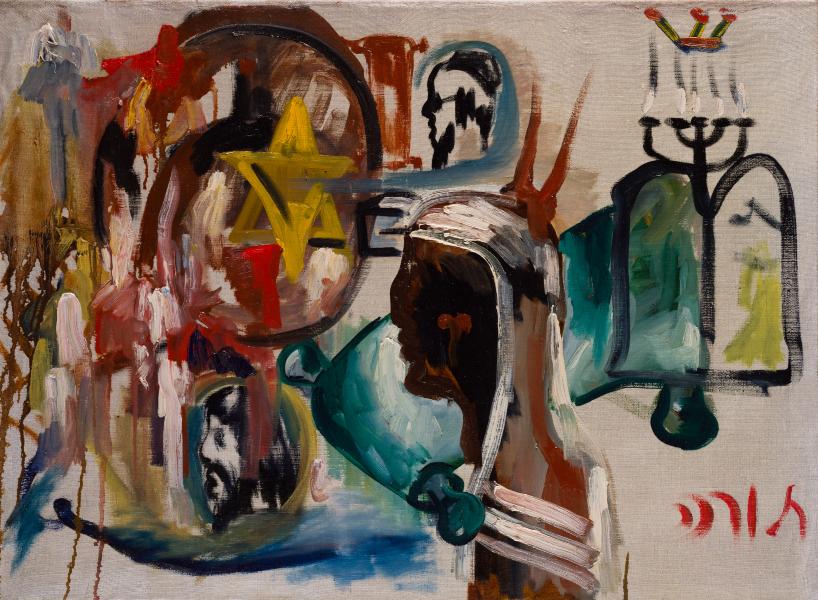
The work was created in the same period as the thematically religious and symbolic "Composition with Candles" (August 1973, inv. number "Ф.Шар.Арх. ЛКГ-12") and "Composition with a Profile" (October 1974, inv. no. "Ф.Шар.Арх.ЛКГ-24"), which belong to "kabbalistic things" (author's definition). However, the language used by the author in this work is undoubtedly emotional, following the practices of Abstract Expressionism, although the motifs used are consonant – from the 21 letters of the Hebrew alphabet שׂ (but the inscription on the work lacks a dot), which is placed above a candelabrum similar to a menorah, but it is designed for five candles (in the right part of the composition). Next to a stylised figure (the prophet Moses?) is the image of a greenish-white scroll on a wooden roll with handles but no inscriptions. It is worth noting that this scroll seems to be a continuation of the two tablets (Luchot habit), which have only one letter similar to ג (gimel), which has been interpreted as reward and punishment, and in particular that a person is free to choose between good and evil. Other texts have an inscription in the lower right corner, immediately below the tablets, in red colour, which is unclear and complicated to determine whether it is גוהר. The left part of the composition is a layer of expressively resolved motifs, including two male profiles. The upper male profile is interpreted linearly; the figure has a beard but no moustache and probably wears thin-rimmed glasses and a velvet kippah with four wedges (Haredi) on the back of his head. The man's gaze is directed towards the scroll with no inscriptions, beside which is a massive linear image of the Star of David (Magen David) in bright yellow paint. Below the image of Magen David is a man's profile, also linearly stylised. This figure has a medium-length beard, moustache, and long black hair that partially covers his neck. There are apparently chaotic lines in front of the man, which could be signs of light spiritual beings. In general, in the absence of the author's interpretation of the plot and any clarifications that could guide the search for deciphering the content, we can say that the work is probably intended for individual perception and a certain freedom of interpretation. In any case, this work by Arnold Sharhorodskyi is one of those exceptional mystical paintings resulting from a personal spiritual quest.
Legal regulation
Borys Voznytskyi Lviv National Art Gallery