Hermit
unknown


Basic information
- ID
- Ж-4749
- Author
- unknown
- Name
- Hermit
- Technique
- oil painting
- Material
- alabaster oil
- Dimensions (height x width, cm)
- 38 x 32
Additionally
- Type
- painting
- Genre
- religious
- Plot
- Saint Jerome
- Provenance
- Lviv Historical Museum
- Exposition
- Potocki Palace
Information about author
Object description
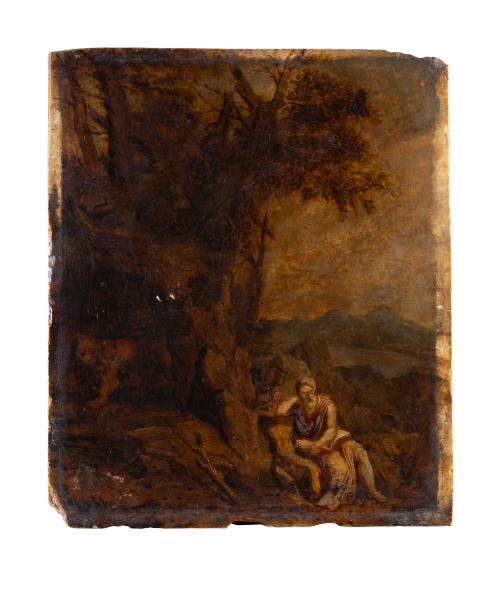
Saint Jerome (c. 342–420 AD) was a theologian, writer, and hermit known for producing the first Latin translation of the Bible – the Vulgate. The saint became a prominent figure in painting during the 17th and 18th centuries following the Council of Trent's declaration of the Vulgate as the official translation of the Bible. Jerome spent four years in the desert, so in many depictions, artists paid considerable attention to the details of the rocky landscape. Saint Jerome is often depicted as a penitent, wearing a loincloth, and portrayed as gaunt and emaciated. He was usually depicted nearly naked, even when shown writing a book, as this was how penitent hermits were portrayed. The attributes of Saint Jerome include a book of Scripture, a cross, a skull, a lion at his feet (according to legend, Jerome removed a thorn from the lion's paw), a dove, a quill, and a stone with which he beats his chest. The artist depicted the saint in a relaxed pose. Amidst a mountainous landscape, a man is portrayed leaning on a stone with his hand. A book rests on his knees. A water clock (clepsydra) is placed on the stone near his left hand. In the distance, to the right of the saint's figure, there is a lake, with mountains further beyond. On the left side of the canvas, there is a rocky formation with trees and a cave. Among the trees, a bird and a wooden cross are depicted. From the darkness of the cave emerges the figure of a lion.
Legal regulation
Borys Voznytskyi Lviv National Art Gallery