Battle II

Joseph Parrocel

  • Battle II 2
  • Battle II 3
Basic information
ID
Ж-793
Author
Joseph Parrocel
Name
Battle II
Date of creation
17th c.
Technique
oil painting
Material
canvas oil
Dimensions (height x width, cm)
53 x 77
Additionally
Information about author
Author
Joseph Parrocel
Artist's lifetime
1646–1704
Country
France
Biography
A French artist from a family of painters and engravers. The family hails from Montbrison in the Loire region and has been one of the most prominent French artistic dynasties since the 16th century, comprising 14 artists over six generations. This dynasty's popularity peaked in the late 17th to 18th centuries. Joseph Parrocel and his son Charles Parrocel (1688–1752) were notable artists known for their battle and hunting scenes. Joseph's nephew, Pierre Parrocel (1670–1739), was a successful painter of religious works, as was his nephew and pupil, Etienne Parrocel (1696–1775), who spent his artistic life in Rome. Joseph Parrocel studied under his father, Barthelemy Parrocel (1595 (?)–1660), and then under his elder brother, Louis Parrocel (1634–1694). The artist moved to Paris for four years to refine his skills. In 1667, he travelled to Rome, where he became a pupil of the battle painter Jacques Courtois and was influenced by Salvator Rosa. He remained in Italy for eight years, living in Venice until returning to Paris in 1675. The artist was accepted (agréé) by the Royal Academy of Painting and Sculpture in February 1676 and received full membership (reçu) in November of the same year, presenting the work "The Siege of Maastricht" (Draguignan, Municipal Museum). The paintings of Joseph Parrocel primarily depict military scenes, including battles. The artist consistently received numerous royal commissions. Between 1685 and 1688, he completed 11 paintings for the Salle du Grand Couvert at the Palace of Versailles. In 1699, he painted "Crossing of the Rhine" (Paris, Louvre) for the Chateau de Marly in Evry, and in 1700, he created "The Fair at Bezons" (Tournai, Museum of Fine Arts). The artist was also known for many works depicting hunting scenes. His most significant religious paintings include "May at Notre-Dame de Paris", "Saint John the Baptist Preaching", and "Saint Augustine Helping the Sick". The artist also created battle scenes against the portraits of Hyacinthe Rigaud and Gabriel Blanchard. Parrocel's technique was unique for his time – he employed a loose style, painting with thick paint and using intense colours. He was also a prolific engraver, creating around 100 plates, including 25 on the sacraments from the life of Jesus Christ and 40 depicting miracles from the life of Jesus Christ. Some of his works depicted military themes. Joseph Parrocel's students included the landscape painter Francois Silvestre (1667–1738), his son Charles Parrocel (1688–1752), and his nephews Ignace-Jacques Parrocel (1667–1722) and Pierre Parrocel (1664–1739).
Object description
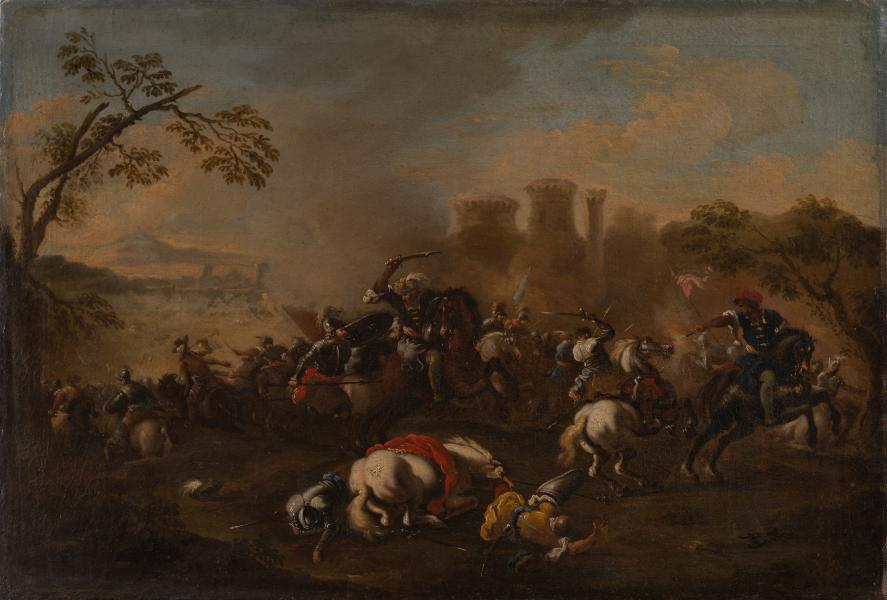
Battle scenes were in high demand among collectors from various social strata. They emphasised the significance of heroic deeds that showcased patriotism and military valour. The composition of the painting is intriguing, as Parrocel succeeded in creating a sense of movement through the arrangement of characters and elements within the scene. The characters are positioned in different canvas planes, creating a sense of depth and perspective. The artist used a palette of dark, rich tones to create a tense and dramatic atmosphere. The work is dominated by reds, ochres, and browns, reflecting the intensity of the battle and the chaos that prevails on the battlefield. The collection of Borys Voznytskyi Lviv National Art Gallery has a pair piece to this work titled "Battle I".
Legal regulation
Borys Voznytskyi Lviv National Art Gallery