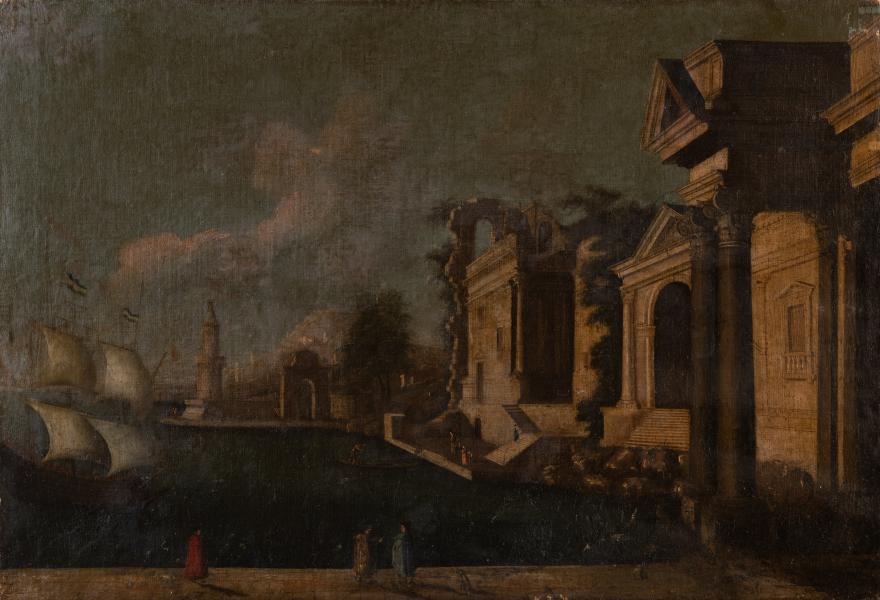
Sea Quay

Giovanni Antonio Canal

  • Sea Quay 2
  • Sea Quay 3
Basic information
ID
Ж-3372
Author
Giovanni Antonio Canal
Name
Sea Quay
Technique
oil painting
Material
canvas oil
Dimensions (height x width, cm)
64 x 94
Additionally
Type
painting
Genre
cityscape
Provenance
Lviv Historical Museum
Exposition
Potocki Palace
Information about author
Author
Giovanni Antonio Canal
Artist's lifetime
1697–1768
Country
Italy
Biography
Giovanni Antonio Canal, also known as Canaletto, was the most prominent and famous representative of Venice's 18th-century cityscape painting. The artist was born into the family of Bernard Canal in 1697. According to biographers, particularly Antonio Maria Zanetti, the artist's father was a "theatre painter" and built a successful career as a scenographic painter. From 1711 to 1728, he worked on scenery for Venice's most famous and prestigious theatres, Sant' Angelo and San Cassiano. Between 1719 and 1720, Bernardo Canal and his son visited Rome. They were both mentioned as scenographers in the libretto of Alessandro Scarlatti's opera during this period. The nickname Canaletto, "little Canal," was most likely given to the artist in Rome. Several Italians were among the artist's patrons in the early period of his career. Still, foreigners, especially those from the British Isles, valued his works much more and constantly added them to their collections. Ambassador Joseph Smith was the main client of the artist and an intermediary between him and English art lovers. In 1746, Canaletto left for England, where he stayed until 1756, but he made several short trips to Europe. Giovanni Antonio Canal returned to Venice in 1760, where he spent the rest of his life.
Object description
The painting is characteristic of Canaletto's style, with great attention to architectural details and perspective and using light and colour to create atmospheric effects. The colours are vivid and bright, with the palette perfectly capturing the sunlight reflecting off the walls of the buildings. The artist also used complementary colours to create striking visual contrasts. Canaletto used light to create dramatic effects in his work. He recreated reflections in the water, shadows on buildings, and the effects of sunlight to give his paintings depth and texture. Human figures dressed in elegant 18th-century costumes and gowns add visual interest to the painting.
Inscriptions
In the bottom right is an inscription: "V. Canaletto".
Legal regulation
Borys Voznytskyi Lviv National Art Gallery